Part 1
What Is Freelancing? A Complete Beginner's Guide to Starting Your Freelance Journey
Part 2
Skills You Can Sell as a Freelancer (Even With No Experience)
Part 3
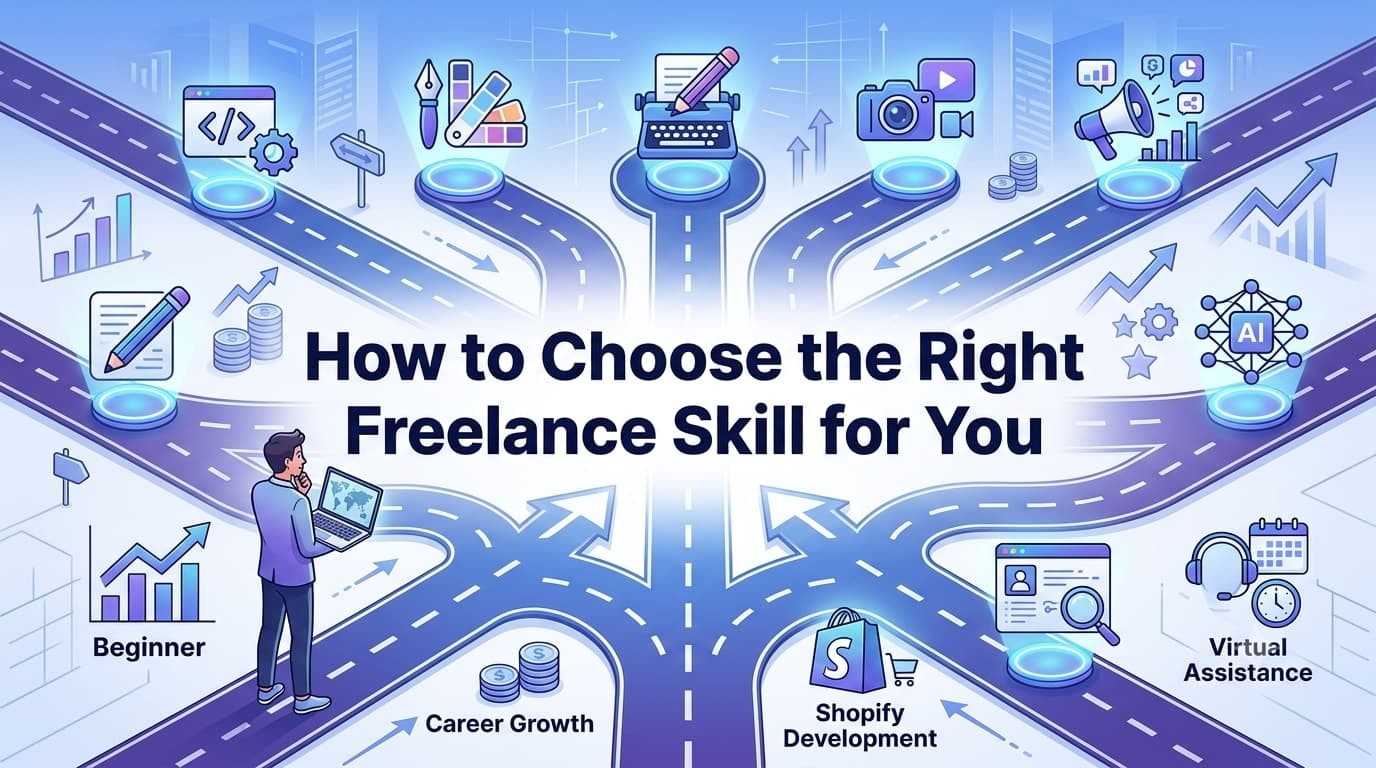
How to Choose the Right Freelance Skill for You
Part 4
Best Freelancing Platforms for Beginners
Part 5
How to Create a Winning Fiverr Profile
Part 6
How to Create an Upwork Profile That Gets Approved
Part 7
How to Get Your First Freelance Client
Part 8
How to Build Your Portfolio Without Clients
Part 9
How Much Should Beginners Charge?
Part 10
Common Freelancing Mistakes Beginners Make
Part 11
How to Communicate With Clients Professionally
Part 12
How to Avoid Freelancing Scams
Part 13
How to Get Repeat Clients
Part 14
How to Scale From Freelancer to Agency
Part 15
Passive Income Ideas for Freelancers
Part 16
AI Tools Every Freelancer Should Use
Part 17
How to Manage Time as a Freelancer
Part 18
Freelancer Taxes and Payments Explained
Part 19
How to Build a Personal Brand as a Freelancer
Part 20
From Beginner to Full-Time Freelancer: A Step-by-Step Roadmap
📘 Learn Freelancing for Beginners – Part 3
Welcome back to the Learn Freelancing for Beginners series!
In Part 1, we explored what freelancing is and how it works. You learned why millions of people around the world are choosing freelancing as a career and what to expect when starting your journey.
In Part 2, we looked at more than 25 freelance skills you can sell—even if you have no professional experience. From web development and graphic design to content writing, AI, and virtual assistance, you discovered that there are countless opportunities available in today's digital economy.
Now comes one of the most important decisions you'll make as a beginner:
"Which freelance skill should I choose?"
At first glance, this seems like a simple question. Many beginners search Google or YouTube for "the highest-paying freelance skill" or "the easiest skill to learn." They often end up with dozens of conflicting opinions, leaving them more confused than when they started.
Some people tell you to learn programming because it pays well.
Others say graphic design is easier.
Some recommend AI because it's the future.
Others insist content writing is the fastest way to earn money.
So who's right?
The truth is, there is no single "best" freelance skill for everyone.
The best freelance skill for you depends on several factors, including:
Your interests
Your natural strengths
Your personality
The amount of time you can invest
Your financial goals
Market demand
Your long-term vision
A skill that helps one person earn $10,000 per month might make another person miserable because it doesn't match their interests or strengths.
Likewise, a skill that seems difficult today might become your greatest competitive advantage if you're passionate enough to keep learning.
One of the biggest mistakes beginners make is choosing a skill based solely on income potential. While earning potential is important, it's only one piece of the puzzle.
Imagine spending months learning a skill you don't enjoy. Eventually, you'll lose motivation, stop practicing, and move on to something else. Unfortunately, many aspiring freelancers repeat this cycle several times and never become truly skilled in any one area.
Instead of chasing trends, you need a systematic way to evaluate your options.
That's exactly what this guide will help you do.
By the end of this article, you'll know how to:
Identify your strengths and interests
Match your personality to suitable freelance careers
Evaluate market demand
Understand learning difficulty
Compare earning potential
Avoid common beginner mistakes
Create a clear learning roadmap
Confidently choose a freelance skill that fits your goals
Most importantly, you'll stop guessing and start making informed decisions.
Let's begin.
Why Choosing the Right Skill Matters
Many beginners believe that choosing a freelance skill isn't a big decision because they can always switch later.
Technically, that's true—but changing direction every few months comes with a cost.
Every time you jump from one skill to another, you reset your progress. You spend weeks learning new tools, building a new portfolio, and starting over from scratch.
Meanwhile, someone who stayed focused on one skill continues improving, building credibility, attracting better clients, and increasing their rates.
Choosing the right freelance skill from the beginning doesn't guarantee instant success, but it significantly improves your chances of staying motivated and achieving long-term growth.
Think of your freelance skill as an investment.
The time you spend learning today can continue paying you for years to come.
That's why it's worth taking a thoughtful, strategic approach instead of simply following whatever is trending on social media.
Start with Self-Assessment
Before looking at freelance platforms or searching for high-paying jobs, take a moment to understand yourself.
Choosing a freelance skill starts with self-awareness.
Ask yourself these questions:
What types of work do I genuinely enjoy?
Which school or university subjects did I like the most?
What hobbies do I spend time on?
What problems do people ask me to help solve?
Do I enjoy working with technology, writing, designing, or communicating?
Do I prefer working independently or collaborating with others?
Am I comfortable learning technical concepts?
What motivates me more: creativity, logic, helping people, or building things?
Write your answers down.
Don't overthink them.
Patterns will begin to emerge.
For example, if you enjoy solving logical problems and working with technology, web development or AI might be a natural fit.
If you enjoy storytelling and communication, content writing or copywriting could be better choices.
If you're highly creative, graphic design or video editing may align well with your strengths.
Remember, self-assessment isn't about finding the "perfect" answer. It's about narrowing your options so you can make a more informed decision.
Discover Your Interests
Interest is often underestimated, but it's one of the biggest factors in long-term success.
When you're interested in a subject, you're naturally more willing to:
Watch tutorials
Read articles
Practice regularly
Solve difficult problems
Stay updated with industry trends
Learning becomes much easier because curiosity keeps you moving forward.
To discover your interests, think about the type of content you already consume.
Do you spend hours watching:
Programming tutorials?
Design inspiration?
Marketing case studies?
YouTube editing tips?
AI demonstrations?
Business podcasts?
Your browsing habits often reveal what genuinely excites you.
However, don't confuse temporary curiosity with long-term interest.
Watching one viral AI video doesn't necessarily mean you want to build a career in AI.
Give yourself time to explore before making a commitment.
Identify Your Natural Strengths
While your interests help you stay motivated, your natural strengths can help you learn faster and perform better.
Everyone has different abilities. Some people naturally enjoy solving logical problems, while others excel at communicating ideas or creating visually appealing designs.
Understanding your strengths doesn't mean you shouldn't challenge yourself—it simply helps you choose a starting point that gives you the highest chance of success.
Ask yourself:
What do friends or colleagues usually compliment you on?
Which tasks feel easier for you than they do for others?
Have you ever taught someone a skill?
What kind of work makes you lose track of time?
What accomplishments are you most proud of?
You can also ask family members, friends, or coworkers for honest feedback. Sometimes, other people notice strengths that we overlook.
Remember, strengths are a starting point—not a limitation. With consistent practice, you can improve almost any skill.
Consider Your Personality Type
Many people ignore personality when choosing a freelance career, but it can have a significant impact on job satisfaction.
Think about how you prefer to work.
Do You Enjoy Solving Technical Problems?
If you enjoy figuring out how things work, debugging issues, or building systems, technical careers may suit you.
Examples include:
Web Development
Shopify Development
WordPress Development
AI Automation
App Development
These careers require analytical thinking and continuous learning.
Are You Creative?
Creative individuals often enjoy expressing ideas visually or through storytelling.
Suitable freelance skills include:
Graphic Design
UI/UX Design
Video Editing
Motion Graphics
Branding
Content Creation
These careers allow you to combine imagination with practical business solutions.
Are You a Strong Communicator?
If you enjoy talking to people, explaining ideas, and building relationships, communication-focused careers might be ideal.
Examples include:
Virtual Assistance
Customer Support
Social Media Management
Copywriting
Email Marketing
Consulting
These skills involve frequent interaction with clients and audiences.
Do You Like Research and Analysis?
If you enjoy gathering information, comparing options, and making data-driven decisions, consider skills like:
SEO
Market Research
Lead Generation
Data Analysis
Business Consulting
Introvert vs. Extrovert
Many beginners ask whether freelancing is better suited for introverts or extroverts.
The truth is—it works well for both.
Introverts often thrive in careers like:
Programming
Writing
Graphic Design
SEO
Video Editing
Extroverts may enjoy:
Consulting
Sales
Coaching
Social Media Management
Client Strategy
Ultimately, communication is important in every freelance career, but you don't need to be highly outgoing to succeed.
Evaluate Market Demand
Even if you love a particular skill, it's important to verify that people are actually paying for it.
This is where market research becomes essential.
A freelance skill is only valuable if businesses are willing to pay for it.
Before committing to months of learning, spend some time researching the market.
Look at Freelance Platforms
Browse platforms like Fiverr and Upwork and search for the skill you're interested in.
Pay attention to:
How many freelancers offer the service?
How many reviews do top freelancers have?
What services are clients requesting?
What are the average prices?
Are businesses hiring regularly?
A healthy marketplace indicates ongoing demand.
Search Job Boards
Many companies hire freelancers directly through job boards and LinkedIn.
If you consistently see openings for a particular skill, it's a strong sign that businesses need those services.
Think Long-Term
Some trends come and go quickly.
Instead of chasing short-lived opportunities, focus on skills that solve ongoing business problems.
For example:
Businesses will always need websites.
Companies will always need marketing.
Brands will always need content.
Customers will always need support.
Choosing evergreen skills provides greater long-term stability.
Think About Your Income Goals
Another important factor is your financial objective.
Ask yourself:
Are You Looking for Extra Income?
If you're a student or working full-time, you might prefer skills that allow you to start earning relatively quickly.
Examples:
Canva Design
Virtual Assistance
Data Entry
Thumbnail Design
These services can help you gain experience while building confidence.
Are You Building a Long-Term Career?
If your goal is to replace a full-time job or build a freelance business, investing more time in advanced skills may be worthwhile.
Examples:
Web Development
Shopify Development
UI/UX Design
AI Automation
SEO
Digital Marketing
Although these skills take longer to master, they often offer higher earning potential and greater career flexibility.
Consider Your Available Time
Be realistic about the time you can dedicate to learning.
There's no shame in learning slowly if you're balancing work, studies, or family responsibilities.
For example:
If You Have 1–2 Hours Per Day
Choose one skill and follow a consistent study schedule.
Even small daily progress adds up over time.
If You Can Study Full-Time
You may be able to build a strong portfolio within a few months by combining structured learning with practical projects.
Avoid Burnout
Learning for 10 hours one day and then taking a week off is less effective than studying consistently for one or two hours every day.
Consistency beats intensity.
Creative Skills vs. Technical Skills
One of the biggest decisions you'll make is whether to pursue a creative or technical freelance career.
Neither option is inherently better—the right choice depends on your strengths and preferences.
Creative Skills
Creative freelancers focus on visual communication, storytelling, and branding.
Examples include:
Graphic Design
UI/UX Design
Video Editing
Motion Graphics
Content Writing
Copywriting
Pros
Creative freedom
Diverse projects
Opportunity to build a unique personal style
Challenges
Subjective client feedback
Frequent revisions
Trends change quickly
Technical Skills
Technical freelancers solve engineering, development, or analytical problems.
Examples include:
Web Development
Shopify Development
AI Automation
SEO
App Development
Pros
Higher average earning potential
Strong global demand
Clear problem-solving objectives
Challenges
Continuous learning
Rapid technology changes
More technical complexity
Many successful freelancers eventually combine both creative and technical skills to provide more comprehensive solutions.
Should You Follow Trends?
If you've spent any time watching freelancing videos on YouTube or scrolling through social media, you've probably seen headlines like:
"Learn AI and Make $10,000 Per Month!"
"This Skill Will Make You Rich!"
"The Best Freelance Skill in 30 Days!"
"This Career Is Dead—Learn This Instead!"
While these headlines grab attention, they rarely tell the whole story.
Yes, technology evolves, and new opportunities appear every year. However, choosing a freelance skill solely because it's trending can be risky.
Trends Change Quickly
Think back five or ten years.
Some skills that were once considered "the future" are no longer as popular, while entirely new industries have emerged.
If you constantly switch to whatever is trending, you'll spend more time learning than earning.
Instead, focus on skills with long-term demand.
For example:
Businesses will always need websites.
Companies will always need marketing.
Customers will always need support.
Brands will always need designers.
Organizations will always need content.
The tools may change, but the business problems remain.
Learn Trends as an Addition, Not a Replacement
This doesn't mean you should ignore new technologies.
For example, if you're a web developer, learning AI-assisted coding tools can make you more productive.
If you're a content writer, learning how to use AI responsibly can help you produce better work.
If you're a graphic designer, AI image generation can speed up your creative process.
Notice the difference?
You're enhancing your core skill instead of abandoning it.
That strategy is far more sustainable.
Skill Stacking: A Smarter Way to Stand Out
One of the biggest secrets of successful freelancers is that they rarely rely on just one skill.
Instead, they combine complementary skills to offer more value.
This strategy is called Skill Stacking.
Instead of trying to become the world's best at one thing, you become very good at several related skills.
Clients love freelancers who can solve multiple problems.
For example:
Web Developer + UI/UX Design
Instead of only building websites, you can also design them.
This means clients don't need to hire two separate freelancers.
Shopify Developer + SEO
You can build an online store and optimize it for search engines.
That's a much more valuable service.
Content Writer + SEO
You won't just write articles.
You'll write articles that rank on Google and generate organic traffic.
Businesses happily pay more for this combination.
Video Editor + Thumbnail Designer
YouTube creators often need both services.
Offering them together increases your value and simplifies the hiring process for clients.
Graphic Designer + Social Media Management
Instead of simply creating graphics, you can also schedule posts, write captions, and manage social media accounts.
This creates opportunities for recurring monthly income.
AI + Any Existing Skill
One of the most valuable combinations today is pairing AI with an existing professional skill.
Examples include:
AI + Web Development
AI + Marketing
AI + Customer Support
AI + Graphic Design
AI + Content Writing
AI shouldn't replace your expertise—it should amplify it.
A Simple Framework for Choosing the Right Skill
If you're still unsure which path to take, use this simple framework.
Think of it as a checklist.
If a skill scores well in most categories, it's probably a good choice.
Am I genuinely interested in learning this skill?
Can I imagine doing this for several years?
Are businesses actively paying for this skill?
Does it match my strengths?
Can I realistically learn it with my available time?
Does it fit my income goals?
Can I build a portfolio without real clients?
Does it have long-term career potential?
If you answer "Yes" to most of these questions, you've probably found a skill worth pursuing.
Decision Paralysis: Don't Get Stuck Forever
One of the biggest obstacles beginners face isn't choosing the wrong skill—it's never choosing at all.
This is known as decision paralysis.
You spend weeks comparing courses.
You watch countless YouTube videos.
You ask for opinions in Facebook groups.
You read Reddit discussions.
Months pass.
Yet you still haven't started learning.
Here's the truth:
You will never have 100% certainty before you begin.
Every successful freelancer eventually reached a point where they simply made a decision and committed to learning.
You can always adjust your path later.
But you can't improve a skill you never start.
A good decision today is far better than a perfect decision that never happens.
Common Mistakes Beginners Make When Choosing a Freelance Skill
Choosing a freelance skill is exciting, but it's also where many beginners unknowingly make costly mistakes. Fortunately, these mistakes are easy to avoid once you're aware of them.
Let's look at the most common ones.
1. Chasing Money Instead of Interest
One of the biggest mistakes is choosing a skill solely because someone on YouTube claimed it pays thousands of dollars per month.
Yes, income potential matters—but if you dislike the work, you'll struggle to stay consistent long enough to become highly skilled.
Instead, look for the intersection of three things:
Something you enjoy learning
Something businesses are willing to pay for
Something you can realistically become good at
That combination usually leads to long-term success.
2. Switching Skills Every Month
Many beginners start learning web development.
After two weeks they switch to graphic design.
A month later they move to AI.
Then video editing.
Then SEO.
Eventually they know a little about many things—but aren't good enough at any one skill to get hired.
Successful freelancers aren't successful because they learned everything.
They're successful because they stayed focused long enough to become valuable.
Commit to one skill for at least 90–180 days before deciding whether to change direction.
3. Underestimating the Learning Process
Many people expect to become job-ready after watching a few YouTube videos.
Learning doesn't happen through watching.
It happens through building.
For example:
Instead of watching ten React tutorials...
Build ten React projects.
Instead of watching logo design videos...
Create fifty logo concepts.
The people who practice the most usually improve the fastest.
4. Ignoring Communication Skills
Clients don't hire robots.
They hire people.
Even if you're technically excellent, poor communication can cost you projects.
Practice:
Writing professional messages
Asking clear questions
Updating clients regularly
Meeting deadlines
Being respectful
Professionalism often wins repeat business.
5. Comparing Yourself to Experts
Social media usually shows the results—not the years of work behind them.
You may see freelancers earning thousands of dollars each month.
What you don't see are:
Hundreds of practice projects
Failed interviews
Rejected proposals
Difficult clients
Late nights learning
Don't compare your Day 1 to someone else's Year 10.
Focus on your own progress.
6. Thinking AI Will Replace Every Freelancer
This is one of the biggest fears among beginners.
The reality is different.
AI is changing how freelancers work—but it isn't eliminating the need for skilled professionals.
Businesses still need people who can:
Think critically
Solve complex problems
Understand client requirements
Make strategic decisions
Communicate effectively
Instead of competing against AI...
Learn how to use AI to become more productive.
7. Waiting Until You Feel "Ready"
You'll never feel completely ready.
Every freelancer starts before they know everything.
The goal isn't perfection.
The goal is continuous improvement.
Start learning.
Start building.
Start applying.
Improve along the way.
Your 30-Day Decision Plan
If you're still unsure where to begin, follow this practical roadmap.
Week 1 — Explore Different Skills
Your objective this week is exploration.
Spend time researching several freelance careers.
Watch beginner tutorials.
Read blog articles.
Browse freelance marketplaces.
Ask yourself:
Which work looks interesting?
Which projects would I enjoy building?
Which skills seem exciting enough to practice daily?
Don't commit yet.
Just explore.
Week 2 — Choose One Skill
Now it's time to make a decision.
Choose one skill.
Not three.
Not five.
One.
Once you've chosen it:
Buy or enroll in one quality course.
Create a learning schedule.
Join relevant communities.
Set realistic goals.
Avoid switching unless you discover it's genuinely not the right fit after giving it enough time.
Week 3 — Start Building
Learning without building is one of the biggest reasons beginners fail.
This week, create small projects.
Examples:
Developers
Landing page
Calculator
Portfolio website
Designers
Brand identity
Social media posts
Mobile app UI
Writers
Blog articles
Product descriptions
Landing page copy
Don't worry if your work isn't perfect.
The purpose is to gain experience.
Week 4 — Evaluate Your Progress
Ask yourself:
Did I enjoy learning?
Did I look forward to practicing?
Can I imagine doing this professionally?
What challenged me the most?
What excited me the most?
If the answers are mostly positive...
Keep going.
If not...
Now is the right time to reassess—not after only three days.
Your Freelance Skill Decision Checklist
Before committing to a skill, make sure you can answer "Yes" to most of these questions.
✅ I'm interested in this skill.
✅ Businesses actively pay for it.
✅ I can learn it with the time I have available.
✅ I understand what beginners need to learn first.
✅ I know where to build my portfolio.
✅ I can imagine doing this for several years.
✅ I understand that success requires practice.
If you checked most of these boxes, you've likely found a great starting point.
Key Takeaways
There is no single "best" freelance skill for everyone.
Choose a skill based on your interests, strengths, personality, and market demand.
Don't chase every new trend. Build a strong foundation first.
Skill stacking can significantly increase your value and income.
Consistency beats constantly switching between different skills.
Build projects instead of only watching tutorials.
Learn to use AI as a productivity tool rather than seeing it as competition.
Remember that your first skill doesn't have to be your last. As your career grows, you can expand into complementary skills.
Frequently Asked Questions
1. How do I know if I've chosen the right freelance skill?
If you enjoy learning it, can stay consistent, and businesses are willing to pay for it, you've likely made a good choice.
2. Should I choose the highest-paying freelance skill?
Not necessarily. A slightly lower-paying skill that you genuinely enjoy may lead to greater long-term success than a high-paying skill you dislike.
3. Can I change my freelance skill later?
Absolutely. Many freelancers evolve throughout their careers. However, avoid changing too frequently before giving yourself enough time to improve.
4. Is it okay to learn more than one skill?
Yes, but focus on mastering one skill first. Once you're confident, expand into complementary skills through skill stacking.
5. What if I don't have any natural talent?
Talent can help, but consistent practice matters much more. Most successful freelancers developed their expertise over time.
6. How long should I stick with a skill before deciding it's not for me?
Give yourself at least three to six months of consistent learning and practice before making a major decision.
7. Can AI help me learn faster?
Yes. AI can explain concepts, generate practice ideas, review your work, and help you solve problems. Use it as a learning assistant rather than relying on it to do everything for you.
8. Do I need expensive courses?
No. Many excellent free resources are available. A structured paid course can save time, but your success depends on practice—not the price of the course.
9. Should I specialize or become a generalist?
Start by specializing in one skill. As you gain experience, add related skills to increase your value and create more service offerings.
10. What's the biggest mistake beginners make?
Trying to learn everything at once instead of becoming really good at one valuable skill.
Continue Learning
📘 Learn Freelancing for Beginners Series
✅ Part 1: What is Freelancing? A Complete Beginner's Guide
✅ Part 2: Skills You Can Sell as a Freelancer (Even With No Experience)
✅ Part 3: How to Choose the Right Freelance Skill for You (Current Article)
➡️ Part 4: How to Learn a Freelance Skill Faster (Without Wasting Time or Money)
Final Thoughts
Choosing your first freelance skill is not about predicting the future—it's about making a thoughtful decision based on who you are today and committing to consistent improvement.
Remember that every expert freelancer started as a beginner. The difference is that they chose a direction, practiced regularly, built real projects, and didn't quit when things became challenging.
Don't spend months waiting for the "perfect" skill or the "perfect" time to begin. Pick one in-demand skill that aligns with your interests and goals, create a learning plan, and take action every day. Small, consistent progress compounds into remarkable results over time.
In the next part of this series, we'll focus on how to learn your chosen freelance skill efficiently, so you can avoid information overload, build practical experience faster, and become job-ready without wasting months on ineffective learning methods.
Need Help? Let's Connect!
Starting your freelancing journey can feel overwhelming, but remember—you don't have to do it alone.
If you have any questions about freelancing, need help choosing a skill, want feedback on your learning roadmap, or simply need guidance on your next step, we're happy to help.
Connect with us on LinkedIn, where we regularly share practical freelancing tips, web development insights, career advice, AI resources, and real-world experiences to help beginners succeed.
💼 Connect with us on LinkedIn:
https://www.linkedin.com/company/moodsharenow
Feel free to send a message—we'd love to hear about your freelancing journey and help you move closer to your goals.
If you found this article valuable, consider sharing it with friends, classmates, or anyone interested in starting a freelance career. Your share could help someone take their very first step toward financial independence.