Part 1
What Is Freelancing? A Complete Beginner's Guide to Starting Your Freelance Journey
Part 2
Skills You Can Sell as a Freelancer (Even With No Experience)
Part 3
How to Choose the Right Freelance Skill for You
Part 4
Best Freelancing Platforms for Beginners
Part 5
How to Create a Winning Fiverr Profile
Part 6
How to Create an Upwork Profile That Gets Approved
Part 7
How to Get Your First Freelance Client
Part 8
How to Build Your Portfolio Without Clients
Part 9
How Much Should Beginners Charge?
Part 10
Common Freelancing Mistakes Beginners Make
Welcome back to the Learn Freelancing for Beginners series!
Starting your freelancing journey is an exciting milestone. You've learned valuable skills, created your portfolio, set up your Fiverr or Upwork profile, and maybe you've even landed your first client.
However, freelancing is about much more than technical skills.
The decisions you make, the way you communicate, and the habits you develop can have a significant impact on your success.
The good news is that most freelancing mistakes are completely avoidable.
In fact, almost every experienced freelancer has made at least one of the mistakes we'll discuss in this article. The difference is that they learned from those experiences and improved over time.
By understanding these common pitfalls early, you can save yourself countless hours of frustration, build stronger client relationships, and grow your freelance career with confidence.
In this guide, we'll explore the most common mistakes beginners make, explain why they happen, and share practical advice to help you avoid them.
Let's get started.
Why Beginners Make Mistakes
Making mistakes is a natural part of learning.
When you're new to freelancing, you're balancing multiple responsibilities for the first time—finding clients, managing projects, communicating professionally, setting prices, and delivering quality work.
It's normal to feel uncertain.
The important thing isn't avoiding every mistake; it's recognizing them early and learning how to respond.
Every challenge is an opportunity to improve your processes, strengthen your skills, and become a more reliable freelancer.
The sooner you develop good habits, the easier it becomes to build a successful and sustainable freelance career.
Mistake #1: Not Choosing a Clear Freelance Niche
One of the biggest mistakes beginners make is trying to offer every service they know.
For example, a freelancer might advertise themselves as:
Web Developer
Graphic Designer
Video Editor
Content Writer
SEO Expert
Social Media Manager
While having multiple skills is valuable, marketing yourself as someone who does "everything" often makes it harder for clients to understand what you're truly good at.
Clients usually prefer specialists over generalists.
Instead of saying:
"I can build websites, edit videos, write blogs, and design logos."
Try saying:
"I help small businesses build fast, responsive websites using React and Next.js."
A clear niche makes your profile easier to understand and increases your chances of attracting the right clients.
Remember, you can always expand your services later as your freelance business grows.
Mistake #2: Charging Too Little
Many beginners believe the fastest way to get clients is by offering the lowest price.
While competitive pricing can help you get started, charging extremely low rates often creates more problems than opportunities.
Very low prices can:
Make clients question the quality of your work.
Attract clients who only care about price.
Leave you feeling overworked and underpaid.
Make it difficult to increase your rates later.
Instead, focus on offering great value.
Set fair introductory prices while you're building experience, then gradually increase your rates as your portfolio, skills, and reviews grow.
Clients don't always hire the cheapest freelancer—they hire the one they trust to deliver results.
Mistake #3: Sending Generic Proposals
Imagine you're a client who receives 30 proposals for a project.
Most of them begin like this:
"Hello Sir, I can do your work. Please hire me."
These messages don't explain why the freelancer is the right fit.
A personalized proposal immediately stands out.
Take time to:
Read the project description carefully.
Mention the client's specific requirements.
Explain how you'll solve their problem.
Highlight relevant experience or portfolio examples.
End with a clear and professional call to action.
Clients appreciate freelancers who show genuine interest in their project instead of sending the same proposal to everyone.
Mistake #4: Poor Communication
Strong communication is one of the most valuable skills a freelancer can develop.
Many projects fail—not because of poor technical skills—but because of misunderstandings.
Good communication includes:
Responding promptly.
Asking questions when requirements are unclear.
Providing regular progress updates.
Being honest about challenges.
Maintaining a professional and respectful tone.
For example, if a deadline may be affected, inform the client as early as possible instead of waiting until the last minute.
Clear communication builds trust, and trust leads to repeat business.
Mistake #5: Missing Deadlines
Clients rely on freelancers to deliver work on time.
Missing deadlines without explanation can quickly damage your reputation.
To stay on schedule:
Break large projects into smaller tasks.
Estimate your time realistically.
Leave extra time for revisions and unexpected issues.
Use task management tools or calendars to stay organized.
If an unexpected situation arises, communicate with the client immediately and discuss a revised timeline.
Most clients appreciate honesty far more than silence.
Mistake #6: Accepting Every Project
When you're new to freelancing, it's tempting to say "yes" to every opportunity.
However, accepting projects outside your expertise can lead to:
Poor-quality work.
Stress and burnout.
Missed deadlines.
Dissatisfied clients.
Negative reviews.
Before accepting a project, ask yourself:
Do I have the skills to complete this successfully?
Can I meet the deadline?
Do I fully understand the client's requirements?
Will this project help me grow?
It's perfectly acceptable to decline projects that aren't the right fit.
Saying "no" to the wrong project allows you to say "yes" to better opportunities later.
Mistake #7: Not Defining Project Scope Clearly
One of the most common causes of frustration in freelancing is scope creep—when a project's requirements continue to grow after work has already begun.
For example, a client hires you to design a five-page website.
A few days later, they ask for:
Two additional pages.
A blog section.
Contact form integration.
SEO optimization.
These requests may seem small individually, but together they can significantly increase the workload.
To avoid misunderstandings, clearly define:
Project deliverables.
Timeline.
Number of revisions.
Features included.
Features not included.
A clear agreement protects both you and your client.
Mistake #8: Ignoring Client Feedback
Receiving feedback can sometimes feel discouraging, especially when you've worked hard on a project.
However, constructive feedback is one of the fastest ways to improve.
Instead of becoming defensive:
Listen carefully.
Ask clarifying questions.
Make thoughtful improvements.
Thank the client for their input.
Every revision is an opportunity to learn something new.
Freelancers who embrace feedback often build stronger client relationships and improve more quickly.
Mistake #9: Stopping Learning After Getting Your First Client
Landing your first freelance client is an exciting achievement, but it shouldn't be the end of your learning journey.
The freelance industry is constantly evolving.
New technologies, design trends, AI tools, marketing strategies, and client expectations emerge every year. Freelancers who continue learning stay competitive and are often able to charge higher rates.
Make learning a regular habit by:
Taking online courses.
Reading industry blogs.
Following experts in your field.
Watching tutorials.
Practicing new technologies.
Building personal projects.
Experimenting with AI tools that improve your workflow.
Continuous learning doesn't mean you need to study every day for hours. Even dedicating a few hours each week can make a significant difference over time.
Mistake #10: Depending on a Single Client
When you finally secure a reliable client, it's easy to become comfortable.
However, relying on one client for all your income can be risky.
Projects may end unexpectedly due to budget changes, business priorities, or market conditions.
Instead, aim to build a diverse client base.
You can do this by:
Staying active on freelance platforms.
Networking on LinkedIn.
Updating your portfolio regularly.
Asking satisfied clients for referrals.
Publishing helpful content related to your expertise.
Diversifying your income reduces risk and creates a more stable freelance career.
Mistake #11: Neglecting Your Professional Online Presence
Many beginners focus only on Fiverr or Upwork and ignore their overall online presence.
Potential clients may search for your name before hiring you.
Having a professional online presence helps build trust.
Consider maintaining:
A personal portfolio website.
An updated LinkedIn profile.
A GitHub profile (for developers).
Behance or Dribbble (for designers).
A professional email address.
A blog where you share your expertise.
A consistent online presence demonstrates professionalism and makes it easier for clients to learn about your work.
Mistake #12: Not Treating Freelancing Like a Business
Freelancing is more than completing projects.
You're also running a business.
Successful freelancers pay attention to:
Client communication.
Time management.
Financial planning.
Marketing.
Skill development.
Personal branding.
Customer satisfaction.
Thinking like a business owner helps you make better long-term decisions.
Instead of asking:
"How do I get my next project?"
Start asking:
"How do I build a freelance business that clients trust and recommend?"
That mindset shift can transform your career.
Other Common Freelancing Mistakes
Here are a few additional mistakes that are easy to overlook but can affect your growth.
Not Backing Up Your Work
Always keep backups of your files.
Use cloud storage services or version control systems to avoid losing important work.
Forgetting to Track Time
Even if you're not charging by the hour, tracking your time helps you estimate future projects more accurately.
Over time, you'll better understand how long different tasks actually take.
Ignoring Your Health
Freelancing often involves long hours in front of a computer.
Take regular breaks, maintain good posture, stay hydrated, and make time for exercise.
Your health directly impacts your productivity and creativity.
Not Setting Working Hours
Being available 24/7 can quickly lead to burnout.
Set clear working hours and communicate them professionally to your clients.
Maintaining a healthy work-life balance is important for long-term success.
Comparing Yourself to Others
It's easy to compare yourself with experienced freelancers who have years of client work and impressive portfolios.
Instead of comparing your beginning to someone else's middle, focus on your own progress.
Measure success by how much you've improved compared to last month—not by someone else's achievements.
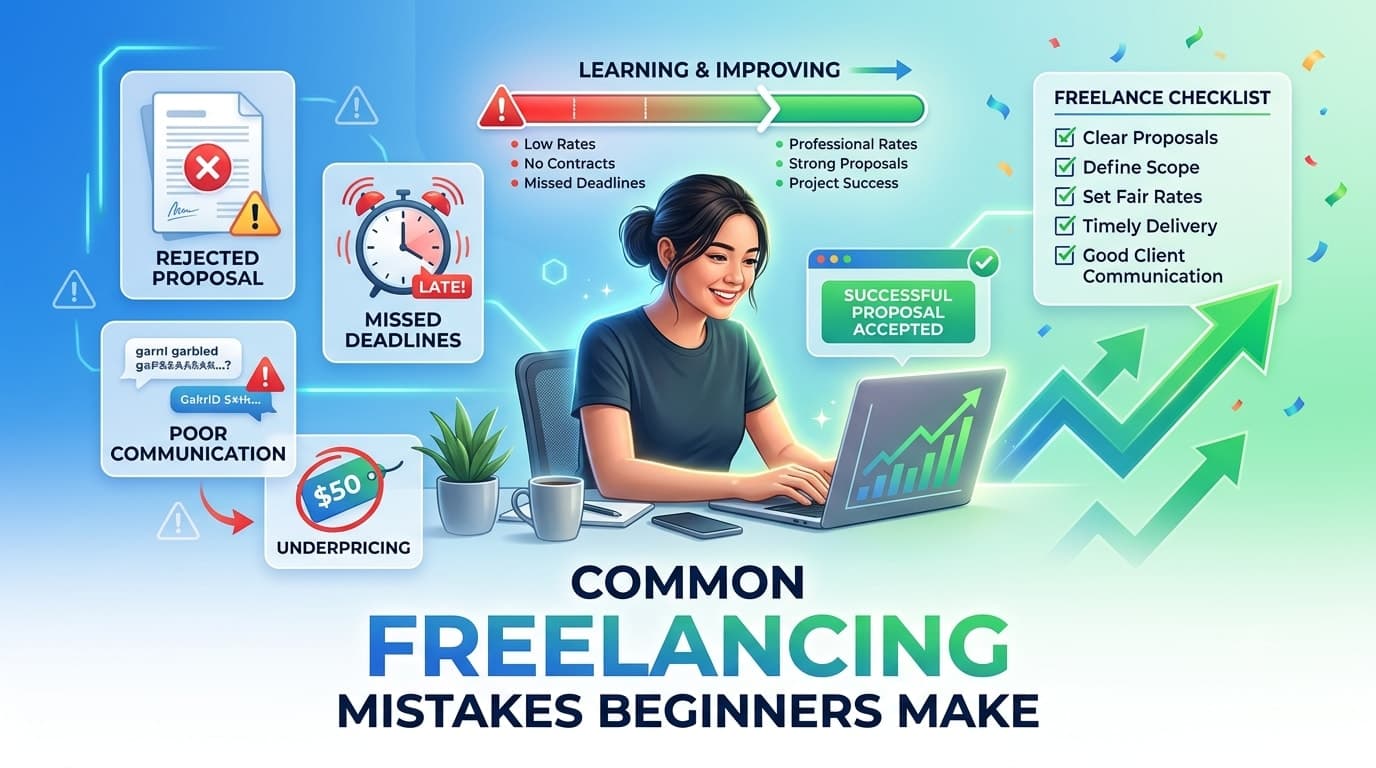
Beginner Success Checklist
Before moving forward in your freelancing journey, review this checklist.
✔ I have chosen a clear freelance niche.
✔ My profile is complete and professional.
✔ My portfolio showcases my best work.
✔ I send personalized proposals.
✔ I communicate professionally with clients.
✔ I deliver projects on time.
✔ I clearly define project scope before starting.
✔ I continue learning and improving my skills.
✔ I'm building my personal brand alongside freelance platforms.
✔ I treat freelancing as a long-term business, not just a side hustle.
The more boxes you can check, the stronger your foundation for long-term freelance success will be.
Key Takeaways
Every freelancer makes mistakes, especially in the beginning.
The important thing is to recognize them early and learn from them.
Here are the biggest lessons from this guide:
Choose a clear niche so clients understand your expertise.
Charge fair prices that reflect the value you provide.
Personalize every proposal instead of using generic templates.
Communicate clearly and professionally throughout every project.
Respect deadlines and manage your time effectively.
Define project scope before starting to avoid misunderstandings.
Welcome client feedback as an opportunity to improve.
Continue learning to stay competitive.
Build multiple client relationships instead of depending on a single source of income.
Treat freelancing as a professional business from day one.
Avoiding these common mistakes won't guarantee instant success, but it will help you build stronger client relationships, earn better reviews, and grow your freelance career more confidently.
Frequently Asked Questions
Is it normal to make mistakes as a beginner freelancer?
Absolutely.
Every freelancer starts somewhere, and mistakes are part of the learning process. The key is to learn from them, improve your approach, and avoid repeating the same mistakes.
What's the biggest mistake beginners make?
There isn't one single mistake, but sending generic proposals, charging too little, poor communication, and failing to define project scope are among the most common reasons beginners struggle to grow.
How can I avoid scope creep?
Before starting a project, clearly define:
Deliverables
Timeline
Number of revisions
Features included
Additional work and pricing
Having these details agreed upon helps prevent misunderstandings later.
Should I say no to projects?
Yes.
If a project is outside your expertise, has unrealistic deadlines, or doesn't align with your goals, it's better to decline it professionally than deliver poor-quality work.
How do successful freelancers continue improving?
Successful freelancers invest in continuous learning, improve their portfolios, follow industry trends, experiment with new tools, and consistently refine their communication and business skills.
Continue Learning
📘 Learn Freelancing for Beginners Series
✅ Part 1: What Is Freelancing? A Complete Beginner's Guide
✅ Part 2: Skills You Can Sell as a Freelancer (Even With No Experience)
✅ Part 3: How to Choose the Right Freelance Skill for You
✅ Part 4: Best Freelancing Platforms for Beginners
✅ Part 5: How to Create a Winning Fiverr Profile
✅ Part 6: How to Create an Upwork Profile That Gets Approved
✅ Part 7: How to Get Your First Freelance Client
✅ Part 8: How to Build Your Portfolio Without Clients
✅ Part 9: How Much Should Beginners Charge?
Final Thoughts
No freelancer has a perfect start. Mistakes are a natural part of learning, but they don't have to define your career. What matters most is how you respond to them.
Each project teaches you something new—whether it's improving your communication, estimating timelines more accurately, refining your pricing, or understanding client expectations. These lessons become the foundation of your professional growth.
Rather than chasing perfection, focus on steady improvement. Build good habits, stay curious, deliver quality work, and always look for ways to provide more value to your clients. Over time, these small improvements compound into a successful and sustainable freelance business.
Remember, the freelancers who succeed aren't the ones who never make mistakes—they're the ones who learn, adapt, and keep moving forward.
Need Help? Let's Connect!
Your freelancing journey doesn't have to be a solo one. Whether you're choosing your first freelance skill, building your portfolio, setting your prices, creating your Fiverr or Upwork profile, writing proposals, or trying to grow your freelance business, we're here to help.
📩 Subscribe to Stay Updated
Don't miss the next article in our Learn Freelancing for Beginners series.
Subscribe to our blog and be the first to receive new articles, practical freelancing tips, and step-by-step guides delivered straight to your inbox. As the series grows, you'll have a complete roadmap to help you build a successful freelance career.
💬 Have a Question? We'd Love to Help
If you have any questions or need guidance at any stage of your freelancing journey, simply visit our Contact Us page and send us your query.
We personally read every message and do our best to respond to all genuine questions. Whether your question is about freelance platforms, pricing, portfolios, proposals, finding clients, or growing your freelance business, we'll be happy to help.
🤝 Connect With Us on LinkedIn
Follow us on LinkedIn for regular freelancing tips, AI tools, web development insights, career advice, and updates whenever a new article in this series is published.
If you found this article helpful, consider sharing it with your friends, classmates, or anyone planning to start freelancing. It could help them avoid common mistakes and begin their freelance journey with greater confidence.