Part 1
What Is Freelancing? A Complete Beginner's Guide to Starting Your Freelance Journey
Part 2
Skills You Can Sell as a Freelancer (Even With No Experience)
Part 3
How to Choose the Right Freelance Skill for You
Part 4
Best Freelancing Platforms for Beginners
Part 5
How to Create a Winning Fiverr Profile
Part 6
How to Create an Upwork Profile That Gets Approved
Part 7
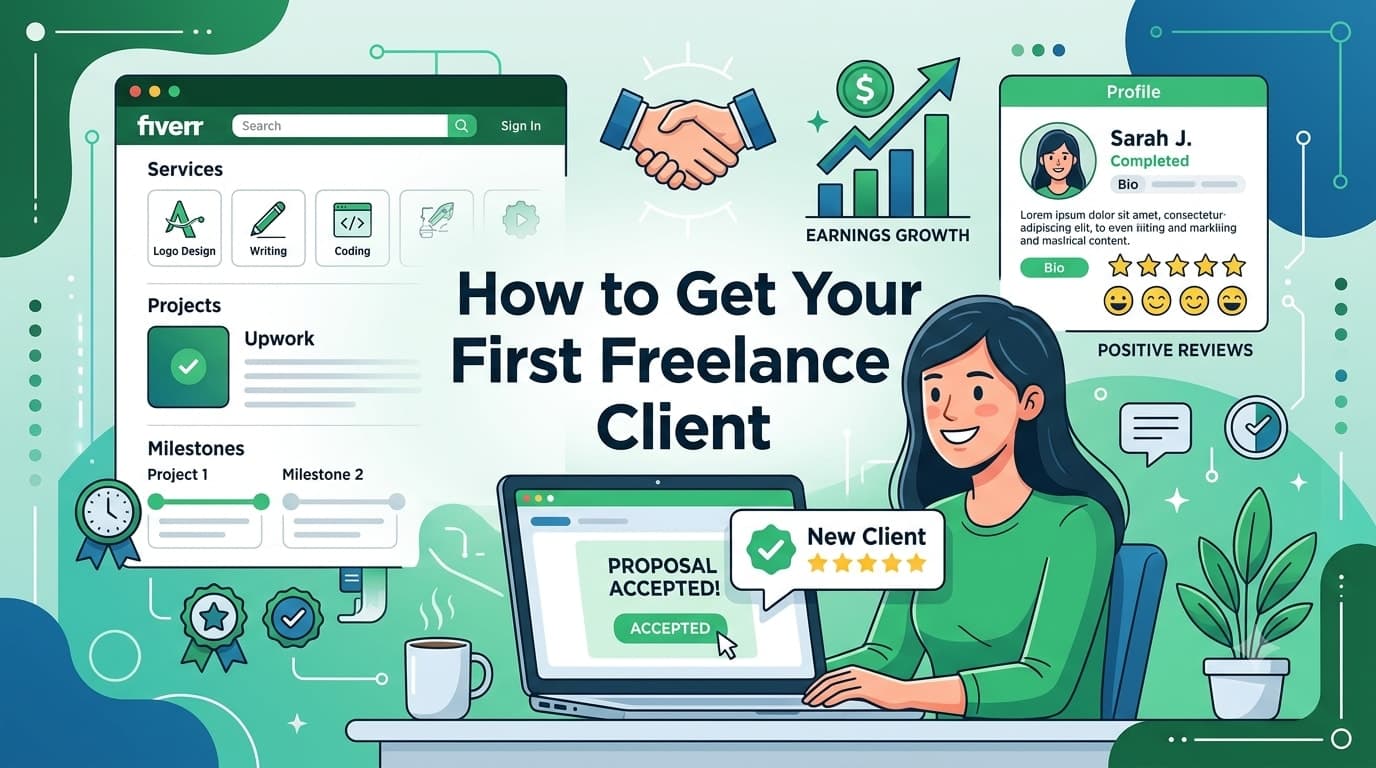
How to Get Your First Freelance Client
Part 8
How to Build Your Portfolio Without Clients
Part 9
How Much Should Beginners Charge?
Part 10
Common Freelancing Mistakes Beginners Make
Welcome back to the Learn Freelancing for Beginners series!
So far, we've covered everything you need to build a strong foundation for your freelance career:
Now comes the question that almost every beginner asks:
"How do I get my first freelance client?"
For many new freelancers, this is the most challenging part of the journey.
You may have learned valuable skills, created an impressive portfolio, optimized your Fiverr and Upwork profiles, and even started sending proposals—but still haven't landed your first project.
If that sounds familiar, don't worry.
Every successful freelancer has faced the same challenge.
The first client is usually the hardest to get because you haven't built reviews, ratings, testimonials, or long-term relationships yet. Clients naturally feel more comfortable hiring freelancers with a proven track record.
The good news is that everyone starts from zero.
The freelancers who succeed aren't always the most experienced—they're often the ones who stay consistent, improve their approach, and keep applying until they earn that first opportunity.
In this guide, you'll learn practical, beginner-friendly strategies to find your first client, stand out from the competition, avoid common mistakes, and build momentum that leads to more freelance work.
Remember, your first client isn't just about earning money—it's about gaining confidence, experience, and the social proof that will make future clients much easier to win.
Let's get started.
Why the First Client Is the Hardest to Get
Landing your first freelance client often feels like trying to get a job that requires experience when you don't have any.
Clients naturally prefer freelancers with:
Positive reviews
Completed projects
Verified experience
Strong portfolios
High response rates
As a beginner, you may not have all of these yet.
That doesn't mean you can't compete.
Instead, you'll need to rely on other strengths, such as:
A professional profile
A high-quality portfolio
Personalized proposals
Clear communication
Reliability
Patience and consistency
The key is understanding that rejection is part of the process.
Many successful freelancers sent dozens of proposals before landing their first client.
Don't measure your success by how quickly you get hired. Measure it by how consistently you're improving your profile, portfolio, and proposal strategy.
Every proposal teaches you something.
Every portfolio project improves your skills.
Every client conversation builds your confidence.
Eventually, one opportunity turns into your first project—and that project opens the door to many more.
Build a Strong Foundation Before Applying
One of the biggest mistakes beginners make is applying for freelance jobs before they're ready.
Imagine you're a client looking to hire a freelancer.
You receive two proposals.
The first freelancer has:
A complete profile
A professional portfolio
Clear communication
Relevant skills
The second freelancer has:
An incomplete profile
No portfolio
A generic proposal
No clear specialization
Who would you choose?
Before sending your first proposal, make sure you've built a solid foundation.
Ask yourself:
Is my profile complete?
Does my portfolio showcase my best work?
Have I clearly defined the services I offer?
Can I confidently deliver the work I'm applying for?
Investing time in preparation dramatically increases your chances of success.
Optimize Your Portfolio
Your portfolio often speaks louder than your proposal.
Clients want proof that you can do the job.
Even if you haven't worked with paying clients yet, you can still create impressive portfolio pieces.
Here are some ideas based on your skill:
Web Developers
Build:
Landing pages
Business websites
Portfolio websites
E-commerce stores
Dashboards
React or Next.js applications
Host your projects online whenever possible and include screenshots with short descriptions.
Graphic Designers
Create:
Logo concepts
Brand identity packages
Social media posts
Flyers
Business cards
Product packaging
Present them professionally using mockups.
Writers
Write sample:
Blog articles
Product descriptions
Landing page copy
SEO content
Email newsletters
Publishing articles on your own blog or platforms like Medium can strengthen your portfolio.
Video Editors
Show examples of:
YouTube videos
Instagram Reels
TikTok edits
Promotional videos
Motion graphics
Keep your portfolio organized and easy to browse.
Choose the Right Freelancing Platform
Not every platform works equally well for every freelancer.
If you're just getting started, focus on one or two platforms instead of trying to be active everywhere.
For example:
Fiverr is great if you want clients to discover your services through gigs.
Upwork is ideal if you prefer applying to projects posted by clients.
Trying to manage multiple platforms at once can become overwhelming.
Master one platform first, then expand as your confidence and client base grow.
Apply to Beginner-Friendly Projects
Many beginners make this mistake:
They immediately apply for large projects worth hundreds or thousands of dollars.
Unfortunately, clients posting high-budget projects usually expect experienced freelancers with proven track records.
Instead, focus on projects that match your current experience.
Look for projects that:
Have clear requirements
Fit your skills
Have realistic deadlines
Are within your ability to complete confidently
Winning several smaller projects is often a better strategy than chasing one large contract.
Every completed project helps you build reviews, confidence, and credibility.
Quality Over Quantity
Some freelancers send 100 copy-and-paste proposals every week.
Others send 10 personalized proposals.
Most clients can immediately recognize a generic proposal.
A thoughtful proposal that addresses the client's specific needs is far more likely to receive a response.
Rather than applying to every available project, choose opportunities that genuinely match your expertise.
Your goal isn't to send the most proposals—it's to send the best ones.
Write Personalized Proposals
One of the fastest ways to lose a client's interest is by sending the same proposal to everyone.
Clients appreciate freelancers who take a few minutes to understand their project.
A good proposal should include:
A friendly greeting
A brief introduction
Evidence that you've read the project description
A short explanation of how you'll solve the client's problem
Relevant experience or portfolio examples
A professional closing with an invitation to discuss the project
Keep your proposal focused on the client's goals rather than listing every skill you have.
Remember, clients aren't hiring you because you know a technology—they're hiring you because you can solve their problem.
Respond Quickly to Messages
Getting a reply from a client is an opportunity you don't want to miss.
Many clients contact multiple freelancers at the same time.
The freelancer who responds promptly and professionally often has an advantage.
When replying:
Answer the client's questions clearly.
Be polite and respectful.
Avoid one-word responses.
Ask relevant questions if something is unclear.
Don't pressure the client to hire you immediately.
Fast, thoughtful communication builds trust from the very beginning.
Be Honest About Your Experience
Some beginners believe they need to exaggerate their experience to win projects.
This approach almost always backfires.
Instead of claiming you've completed hundreds of projects, be honest about your current level while emphasizing your commitment to delivering quality work.
For example:
"Although I'm new to freelancing, I've built several practice projects and I'm confident in my ability to deliver high-quality work. I'm committed to clear communication, meeting deadlines, and ensuring you're satisfied with the final result."
Honesty builds trust—and trust is one of the most valuable assets in freelancing.
Deliver More Than Expected
Once you land your first project, your goal isn't just to complete it—it's to leave a lasting positive impression.
Whenever possible:
Deliver on time or early.
Double-check your work before submitting it.
Fix small issues proactively.
Communicate throughout the project.
Be courteous and professional.
Small gestures, such as providing clear documentation or suggesting helpful improvements, can exceed client expectations and encourage repeat business.
Remember, a satisfied client is more likely to leave a positive review and recommend you to others.
Ask for Reviews Professionally
Your first few client reviews are incredibly valuable.
Positive reviews increase your credibility, improve your visibility on freelance platforms, and make future clients more confident in hiring you.
However, there's a right way to ask for them.
Once you've successfully completed a project and the client is satisfied with your work, you can politely ask if they'd be willing to leave a review.
For example:
"I'm glad you're happy with the project. If you have a moment, I'd really appreciate it if you could leave a review about your experience. It helps me grow as a freelancer."
Keep it friendly and professional.
Never pressure clients or repeatedly ask for reviews.
A genuine review from a satisfied client is worth much more than forcing one.
Find Clients Outside Freelancing Platforms
While Fiverr and Upwork are excellent places to start, they aren't the only places where clients look for freelancers.
Expanding your reach can help you find more opportunities and build a stronger freelance business.
Use LinkedIn
LinkedIn is one of the best platforms for networking with business owners, recruiters, and potential clients.
Optimize your profile by:
Clearly stating your freelance services
Sharing your portfolio
Publishing helpful content
Connecting with professionals in your industry
Engaging with relevant posts
Consistent activity helps you become more visible over time.
Create a Personal Portfolio Website
A personal website gives you complete control over how you present your work.
Your website can include:
About Me
Services
Portfolio
Testimonials
Blog
Contact Form
Having your own website makes you appear more professional and allows potential clients to learn more about your expertise.
Use Social Media Professionally
Platforms like:
LinkedIn
X (formerly Twitter)
Facebook
Instagram
can help you showcase your work and connect with potential clients.
Instead of constantly promoting your services, share valuable content such as:
Tips
Tutorials
Project case studies
Before-and-after transformations
Lessons you've learned
People are more likely to hire freelancers who consistently demonstrate their expertise.
Ask Friends and Family
Don't underestimate your personal network.
Let friends, relatives, classmates, and former colleagues know about the services you offer.
Your first client might come from someone who already knows and trusts you.
Word-of-mouth referrals remain one of the most effective ways to find freelance work.
Join Online Communities
Many clients look for freelancers in online communities.
Consider participating in:
Facebook groups
LinkedIn groups
Reddit communities
Discord servers
Slack communities
Focus on helping others rather than immediately promoting your services.
People remember those who provide useful advice.
Build Your Personal Brand
Clients don't just hire freelancers.
They hire people they trust.
That's why building a personal brand is one of the smartest long-term investments you can make.
Your personal brand is how people perceive you online.
It includes:
Your portfolio
Your LinkedIn profile
Your website
Your social media presence
Your communication style
Your reputation
When people consistently see you sharing valuable content and delivering quality work, they begin to associate your name with expertise.
Over time, clients may start reaching out to you instead of the other way around.
Network Consistently
Networking isn't about asking strangers for work.
It's about building genuine professional relationships.
Here are a few simple ways to network:
Connect with professionals in your industry.
Congratulate people on their achievements.
Comment thoughtfully on industry posts.
Share useful insights and experiences.
Attend webinars and online events.
Participate in local tech or business meetups when possible.
Networking is a long-term strategy.
The relationships you build today could lead to opportunities months or even years later.
Be Consistent and Patient
One of the biggest reasons beginners quit freelancing is because they expect instant results.
You might send several proposals before receiving your first reply.
That's normal.
Instead of getting discouraged, focus on improving every week.
For example:
Refine your profile.
Improve your portfolio.
Write better proposals.
Learn new skills.
Study successful freelancers.
Practice communication.
Consistency compounds over time.
The freelancer who improves a little every day will usually outperform someone who gives up after a few rejections.
Remember, freelancing is a marathon—not a sprint.
Common Mistakes That Prevent Beginners From Getting Clients
Avoiding common mistakes can save you weeks—or even months—of frustration.
Here are some of the biggest ones.
Applying for Every Project
Not every project is the right fit.
Focus on opportunities that match your skills and experience.
Quality applications are far more effective than sending dozens of generic proposals.
Ignoring the Client's Requirements
Always read the project description carefully.
If a client asks a specific question or requests a keyword in the proposal, follow those instructions.
Missing simple requirements can result in immediate rejection.
Competing Only on Price
Offering the lowest price isn't always the best strategy.
Many clients are looking for quality, reliability, and communication—not just the cheapest freelancer.
Charge a fair rate and focus on demonstrating value.
Giving Up Too Early
Many freelancers quit after sending five or ten proposals.
In reality, it often takes persistence to win your first project.
Treat every proposal as practice and continue improving your approach.
Poor Communication
Delayed responses, unclear messages, or unprofessional language can discourage clients.
Always communicate politely, clearly, and promptly.
Good communication is one of the easiest ways to stand out.
First Client Action Plan
If you're serious about getting your first freelance client, follow this simple action plan.
Today:
Complete your freelance profile.
Update your portfolio with your best work.
Decide on one primary service.
This Week:
Apply to 5–10 relevant projects with personalized proposals.
Share your services on LinkedIn.
Reach out to your network.
Improve one portfolio project.
This Month:
Continue applying consistently.
Learn from every response.
Refine your profile based on feedback.
Stay active and keep improving.
The goal isn't just to get one client—it's to build habits that lead to a sustainable freelance career.
Key Takeaways
Getting your first freelance client isn't about luck—it's about preparation, consistency, and persistence.
Here are the most important lessons from this guide:
Build a complete and professional freelancer profile before applying for projects.
Create a portfolio that showcases your best work, even if it's based on personal or practice projects.
Focus on one or two freelance platforms instead of trying to be everywhere at once.
Apply only to projects that match your skills and experience.
Write personalized proposals that address the client's specific needs.
Communicate professionally and respond to client messages promptly.
Deliver high-quality work and aim to exceed client expectations.
Ask satisfied clients for reviews in a polite and professional manner.
Promote your services outside freelance platforms through LinkedIn, your portfolio website, and networking.
Be patient and consistent. Every successful freelancer started with zero clients.
Your first client is often the hardest to get, but once you've completed your first project and earned a positive review, finding your next client becomes much easier.
Frequently Asked Questions
How long does it take to get the first freelance client?
There's no fixed timeline. Some freelancers land their first client within a few days, while others may take several weeks or even months. It depends on your skills, profile quality, portfolio, proposals, competition, and consistency.
Should I work for free to get my first client?
Generally, no.
Working for free can undervalue your skills and set unrealistic expectations. Instead, consider offering a competitive introductory price while maintaining professional quality.
How many proposals should I send each day?
Focus on quality over quantity.
Sending 3–5 personalized proposals each day is often more effective than sending dozens of generic ones.
What if clients don't reply to my proposals?
Don't take it personally.
Review your proposal, improve it, strengthen your profile, and continue applying. Many successful freelancers received numerous rejections before landing their first project.
Can I get clients without Fiverr or Upwork?
Yes.
Many freelancers find clients through:
LinkedIn
Personal websites
Referrals
Social media
Online communities
Networking events
Diversifying your client sources is a smart long-term strategy.
What should I do after getting my first client?
Focus on delivering exceptional work.
Meet deadlines, communicate clearly, solve problems proactively, and leave a positive impression. A happy client may become a repeat customer and recommend you to others.
Continue Learning
📘 Learn Freelancing for Beginners Series
✅ Part 1: What Is Freelancing? A Complete Beginner's Guide
✅ Part 2: Skills You Can Sell as a Freelancer (Even With No Experience)
✅ Part 3: How to Choose the Right Freelance Skill for You
✅ Part 4: Best Freelancing Platforms for Beginners
✅ Part 5: How to Create a Winning Fiverr Profile
✅ Part 6: How to Create an Upwork Profile That Gets Approved
Final Thoughts
Landing your first freelance client can feel like the biggest hurdle in your freelancing journey, but it's also one of the most rewarding milestones. It proves that someone trusts your skills enough to invest in your work.
Don't let a lack of experience discourage you. Every freelancer you admire once started with an empty profile, no reviews, and no clients. What set them apart wasn't luck—it was persistence, continuous learning, and a willingness to improve after every application and project.
Focus on building trust rather than chasing quick results. Invest time in your profile, create a portfolio you're proud of, write thoughtful proposals, and communicate professionally. Small improvements made consistently can lead to significant opportunities over time.
Most importantly, remember that freelancing is a long-term career. Your first client is just the beginning. As you complete more projects, collect positive reviews, and refine your skills, you'll find it easier to attract higher-paying clients and grow a sustainable freelance business.
Stay patient, keep learning, and don't stop applying. Your next proposal could be the one that launches your freelancing career.
Need Help? Let's Connect!
Starting your freelancing journey doesn't have to be overwhelming. Whether you need guidance on choosing a skill, improving your portfolio, creating a stronger Fiverr or Upwork profile, writing better proposals, or finding your first client, we're here to help.
Connect with us on LinkedIn, where we regularly share practical freelancing tips, platform guides, AI tools, web development insights, career advice, and real-world experiences to help beginners build successful freelance careers.
If you have any questions about freelancing, feel free to reach out. We'd be happy to help you take the next step toward achieving your goals.
If you found this article helpful, consider sharing it with friends, classmates, or anyone interested in starting freelancing. You never know—it might be the resource that helps someone land their very first client.