Part 1
What Is Freelancing? A Complete Beginner's Guide to Starting Your Freelance Journey
Part 2
Skills You Can Sell as a Freelancer (Even With No Experience)
Part 3
How to Choose the Right Freelance Skill for You
Part 4
Best Freelancing Platforms for Beginners
Part 5
How to Create a Winning Fiverr Profile
Part 6
How to Create an Upwork Profile That Gets Approved
Part 7
How to Get Your First Freelance Client
Part 8
How to Build Your Portfolio Without Clients
Part 9
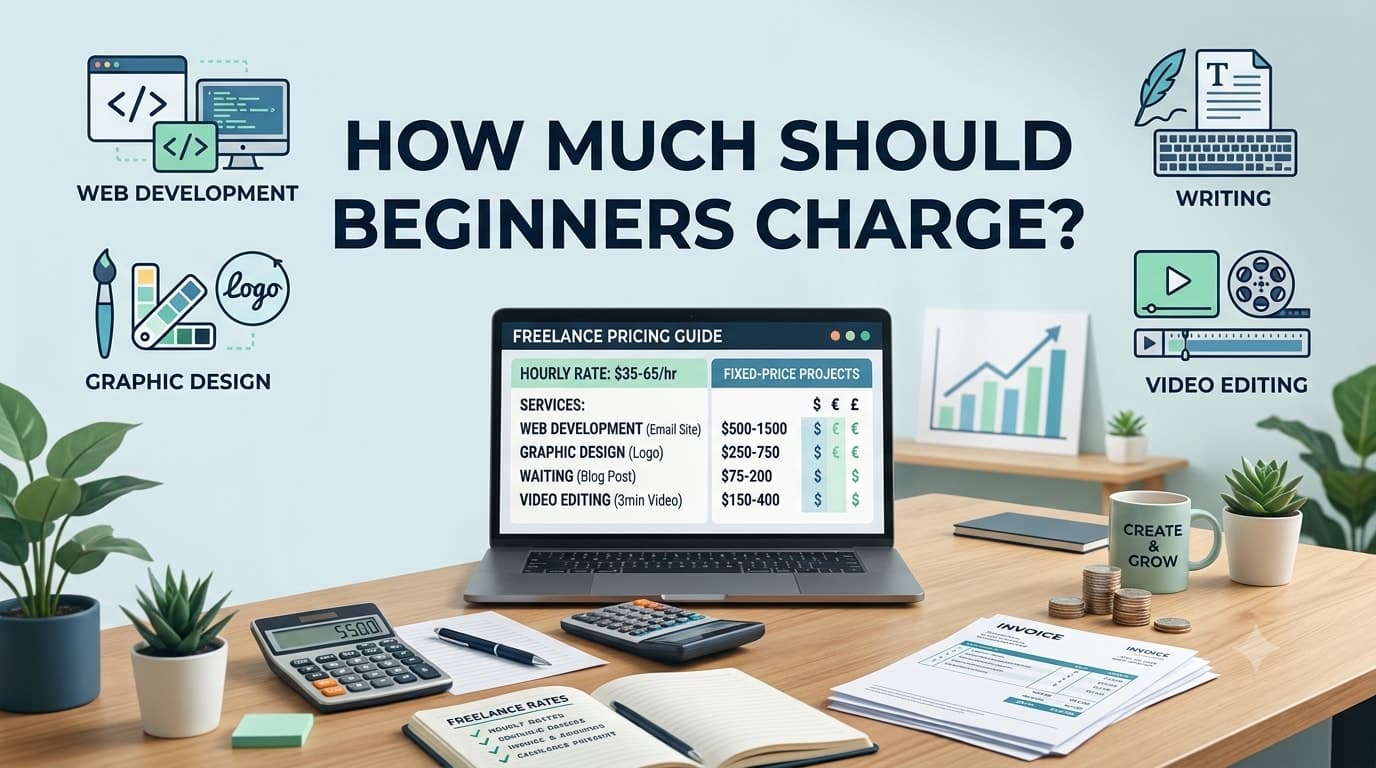
How Much Should Beginners Charge?
Part 10
Common Freelancing Mistakes Beginners Make
Welcome back to the Learn Freelancing for Beginners series!
By now, you've learned how freelancing works, chosen a skill, built your portfolio, created professional profiles, and discovered how to find your first clients.
Now comes another question that almost every beginner asks:
"How much should I charge for my work?"
Setting your freelance rates can feel overwhelming.
Charge too much, and you may worry that clients won't hire you.
Charge too little, and you risk undervaluing your skills, attracting the wrong clients, and making it difficult to grow your freelance business.
Many beginners believe that the only way to get clients is by offering the lowest price.
In reality, pricing isn't just about being cheaper than everyone else.
Clients are looking for freelancers who provide value, communicate well, and deliver quality work. While price is important, it's only one part of the hiring decision.
The goal isn't to be the cheapest freelancer—it's to offer fair pricing that reflects your current skills while allowing you to grow as you gain experience.
In this guide, you'll learn how to determine your freelance rates, understand different pricing models, avoid common pricing mistakes, and increase your rates with confidence as your freelance career progresses.
Let's get started.
Why Pricing Matters
Your pricing does more than determine how much money you earn.
It also influences how clients perceive your services.
Many beginners assume that offering the lowest possible price will help them win more projects.
While a competitive price can help you get started, charging too little often creates unexpected problems.
For example:
Clients may question the quality of your work.
Low-paying projects can consume valuable time.
It becomes difficult to increase your rates later.
You may attract clients who prioritize price over quality.
On the other hand, charging unrealistically high rates without the skills or portfolio to justify them can also make it difficult to win projects.
The key is to find a balance.
Your pricing should reflect your current experience, the value you provide, and the complexity of the work.
As your portfolio, reviews, and expertise grow, your rates should grow too.
Understand the Different Pricing Models
Before deciding how much to charge, it's important to understand the common pricing models used by freelancers.
Each pricing method has its advantages, and choosing the right one depends on the type of project and your level of experience.
The three most common pricing models are:
Hourly pricing
Fixed-price projects
Value-based pricing
Let's look at each one.
Hourly Pricing
With hourly pricing, you charge clients based on the amount of time you spend working.
For example, if your hourly rate is $20 and a project takes 10 hours, you'll earn $200.
Hourly pricing works well for:
Ongoing projects
Website maintenance
Consulting
Bug fixes
Technical support
Projects with changing requirements
Advantages
You're paid for the actual time you work.
Easier to handle projects where the scope may change.
Suitable for long-term client relationships.
Challenges
Clients may compare freelancers based only on hourly rates.
Your income is directly tied to the number of hours you work.
Faster work doesn't always mean higher earnings.
As your experience grows, your hourly rate should increase to reflect the value you provide.
Fixed-Price Projects
With fixed pricing, you agree on a total cost before starting the project.
For example:
Landing page — $150
Logo design — $100
Blog article — $50
Shopify store setup — $400
Regardless of the time it takes, the agreed price remains the same unless the project scope changes.
Advantages
Clients know exactly what they'll pay.
You can earn more if you complete projects efficiently.
Easier to estimate income for each project.
Challenges
Poor planning can reduce your profit.
Scope creep can become a problem if requirements keep changing.
Before accepting a fixed-price project, make sure both you and the client clearly understand:
Project requirements
Deliverables
Timeline
Revision policy
A clear agreement helps prevent misunderstandings later.
Value-Based Pricing
Instead of charging based on hours or tasks, value-based pricing focuses on the value your work brings to the client.
For example:
Imagine a landing page you build helps a business generate thousands of dollars in new sales.
In that case, your work may be worth much more than the number of hours you spent creating it.
This pricing model is common among experienced freelancers and consultants who specialize in solving business problems.
If you're just starting your freelance journey, don't worry about value-based pricing yet.
As you gain experience, understand client needs, and deliver measurable results, you'll naturally become more comfortable using this approach.
Hourly vs Fixed Pricing
One of the most common questions beginners ask is:
"Should I charge hourly or offer fixed-price projects?"
The answer depends on the type of work.
Hourly Pricing Is Often Better For
Ongoing maintenance
Technical support
Consulting
Long-term contracts
Projects with changing requirements
Fixed Pricing Is Often Better For
Landing pages
Logo design
Website development
Blog writing
Mobile app design
One-time development tasks
Many freelancers eventually use both models depending on the project.
If you're unsure, start with the pricing method that you're most comfortable explaining to your clients.
Factors That Affect Your Freelance Rates
There isn't a single "correct" rate for every freelancer.
Your pricing depends on several factors.
Your Experience
Someone with one year of experience will naturally charge differently from someone with ten years of experience.
As you complete more projects and gain confidence, increasing your rates becomes much easier.
Your Skills
Specialized skills generally command higher rates than general skills.
For example, a freelancer specializing in:
React
Next.js
Shopify Development
AI Integration
Cloud Technologies
may charge more than someone offering very broad, general services.
The more valuable and in-demand your expertise becomes, the greater your earning potential.
Portfolio Quality
Clients often evaluate your work before discussing your price.
A strong portfolio demonstrates your ability to deliver results and can justify higher rates.
Investing time in improving your portfolio is one of the best ways to increase your future earnings.
Client Budget
Different clients have different budgets.
A startup, a small business, and a large enterprise may all have different expectations regarding pricing.
Instead of assuming every client wants the lowest price, focus on understanding their requirements and proposing a fair rate based on the work involved.
Project Complexity
Not every project requires the same level of effort.
For example, updating text on an existing webpage is very different from building a complete e-commerce platform.
When estimating your price, consider:
Technical difficulty
Estimated time
Number of deliverables
Research required
Communication and meetings
Revisions
More complex projects typically justify higher rates.
Research the Market Before Setting Your Prices
One of the smartest things you can do before deciding your rates is to research other freelancers offering similar services.
Browse platforms like Fiverr and Upwork and look at professionals who have:
Similar experience
Similar skills
Similar portfolio quality
Similar target audience
Pay attention to:
How they describe their services
Their pricing structure
What's included in their packages
How they position themselves
The goal isn't to copy anyone.
Instead, use this research to understand market expectations and identify opportunities to differentiate yourself.
Should Beginners Charge Less?
One of the biggest misconceptions about freelancing is that beginners should always charge the lowest possible price.
While it's true that you may not be able to charge premium rates immediately, pricing yourself too low can actually hurt your freelance career.
Clients often associate extremely low prices with:
Low-quality work
Lack of confidence
Limited experience
Poor communication
Instead of trying to be the cheapest freelancer, aim to provide excellent value at a fair price.
Your goal should be to build trust, gain experience, and earn positive reviews—not to compete solely on price.
Offer Introductory Pricing, Not Permanent Discounts
As a beginner, it's perfectly reasonable to start with slightly lower rates while you're building your portfolio and collecting your first reviews.
However, think of this as introductory pricing, not your permanent rate.
For example, you might charge a little less for your first few projects to establish credibility.
Once you've completed several successful projects and received positive feedback, gradually adjust your prices to reflect your growing experience.
Avoid staying at beginner rates for too long.
Focus on Value Instead of Price
Clients don't hire freelancers simply because they're affordable.
They hire freelancers because they believe they'll receive value.
You can increase your perceived value by:
Communicating professionally
Responding quickly
Delivering projects on time
Paying attention to details
Suggesting improvements
Providing a smooth client experience
Two freelancers may charge the same amount, but the one who delivers a better experience is far more likely to receive repeat business.
Never Compete Only on Price
If your only advantage is being cheaper than everyone else, you'll constantly struggle to attract quality clients.
There will always be someone willing to charge less.
Instead, compete on things that are difficult to copy, such as:
Professional communication
Reliability
Quality of work
Problem-solving skills
Fast response times
Clear project planning
Attention to detail
These qualities help you stand out without starting a price war.
When Should You Increase Your Rates?
Many freelancers hesitate to increase their prices because they worry about losing clients.
The truth is that increasing your rates is a normal part of growing your freelance business.
Here are some signs that it may be time to charge more.
You're Receiving Consistent Positive Reviews
When clients regularly leave positive feedback and recommend your services, it shows that you're delivering value.
Positive reviews increase your credibility and justify higher rates.
You're Receiving More Work Than You Can Handle
If your schedule is consistently full and you're turning away projects, demand for your services has increased.
This is often a good indication that your rates can be adjusted.
Higher prices can help you manage your workload while increasing your income.
Your Skills Have Improved
Perhaps you've learned:
A new programming language
An advanced design tool
AI integration
Cloud technologies
Automation
Performance optimization
As your expertise grows, so does the value you offer clients.
Your pricing should reflect that growth.
You're Delivering Better Results
If your work now helps clients:
Increase sales
Improve conversions
Save time
Enhance user experience
Reduce costs
you're creating greater value than when you first started.
It's reasonable for your rates to evolve alongside the results you deliver.
How to Increase Your Rates Professionally
Raising your prices doesn't need to feel uncomfortable.
When working with new clients, simply quote your updated rates confidently.
For existing long-term clients, communicate openly and professionally.
For example:
"I've really enjoyed working with you over the past few months. Since we've started, I've expanded my experience and refined my services. Beginning next month, my updated rate will be $X per hour for new work. I wanted to let you know in advance and truly appreciate your continued trust."
Most professional clients understand that rates increase as freelancers gain experience and improve their services.
Common Freelance Pricing Mistakes
Avoiding these mistakes can save you time, frustration, and lost income.
Charging Without Understanding the Project
Never quote a price before fully understanding the client's requirements.
Ask questions such as:
What are the project goals?
What's included?
What's the deadline?
How many revisions are expected?
Are there any specific technical requirements?
The more information you gather, the more accurate your pricing will be.
Forgetting About Revisions
Revisions are a normal part of freelance work.
However, unlimited revisions can quickly turn a profitable project into an unprofitable one.
Clearly define:
What's included
Number of revisions
Additional revision costs (if applicable)
Setting expectations early helps prevent misunderstandings.
Ignoring Hidden Time
When estimating a project, many beginners only consider the time spent creating the final deliverable.
Remember to include time for:
Client meetings
Research
Planning
Testing
Documentation
Emails
Revisions
All of these activities require time and should be considered when setting your rates.
Copying Someone Else's Prices
Every freelancer has different:
Experience
Skills
Expenses
Location
Goals
Target clients
Don't assume someone else's pricing is right for you.
Use competitor research as a reference, but create a pricing strategy that matches your own experience and business objectives.
Being Afraid to Discuss Pricing
Talking about money can feel uncomfortable at first.
Remember that pricing is simply part of doing business.
Discuss your rates confidently, explain what's included, and be transparent about your process.
Professional clients appreciate clear communication.
Freelance Pricing Checklist
Before sending a quote to a client, review this checklist.
✔ I fully understand the project requirements.
✔ My pricing reflects the project's complexity.
✔ I've considered research, communication, testing, and revisions.
✔ My rate is competitive without undervaluing my work.
✔ The deliverables are clearly defined.
✔ The timeline has been agreed upon.
✔ The client understands what's included.
✔ I feel confident delivering the project at this price.
If you can confidently check each item, you're in a strong position to submit your quote.
Key Takeaways
Pricing your freelance services can feel challenging at first, but it becomes much easier as you gain experience and understand the value you provide.
Here are the most important lessons from this guide:
Choose a pricing model that suits your services and the project requirements.
Understand the differences between hourly, fixed-price, and value-based pricing.
Research the market to understand what freelancers with similar skills are charging.
Don't compete only on price—focus on delivering quality and professionalism.
Consider your experience, portfolio, skills, and project complexity when setting your rates.
Start with fair introductory pricing if you're a beginner, but don't stay there forever.
Review your rates regularly as your skills, portfolio, and client reviews grow.
Communicate your pricing clearly and professionally.
Always define project scope, timelines, and revision limits before starting work.
Remember that your goal is to build a sustainable freelance business, not simply win the cheapest projects.
The right clients don't just look for the lowest price—they look for freelancers who can solve their problems and deliver reliable results.
Frequently Asked Questions
Should beginners charge by the hour or per project?
There's no single correct answer.
For small, clearly defined projects, fixed pricing is often easier for both you and the client.
For ongoing work, maintenance, consulting, or projects with changing requirements, hourly pricing may be a better option.
Choose the pricing model that best fits the project and your level of experience.
How do I know if my prices are too low?
If you're consistently winning projects without much discussion about price, receiving more work than you can comfortably handle, or clients immediately accept every quote without negotiation, it may be a sign that your rates are lower than the market expects.
Review your pricing regularly and adjust it as your experience grows.
What if a client says my price is too high?
Stay professional and ask about their budget and expectations.
Sometimes you can adjust the project scope instead of lowering your rate.
For example, you might reduce the number of deliverables or optional features while maintaining the quality of the core work.
Remember, not every client will be the right fit—and that's perfectly normal.
Should I negotiate my rates?
Negotiation is a common part of freelancing.
Be open to discussing the project, but avoid reducing your price without understanding why.
If you offer a discount, explain what changes in return, such as a smaller scope, fewer revisions, or a longer timeline.
This keeps the conversation professional and protects the value of your work.
How often should I increase my rates?
There isn't a fixed schedule.
Consider reviewing your rates whenever you:
Complete several successful projects.
Receive consistent positive reviews.
Learn valuable new skills.
Improve your portfolio.
Notice increased demand for your services.
Many freelancers review their pricing every six to twelve months, but your timeline may vary based on your growth.
Can I charge different prices for different clients?
Yes.
Pricing can vary depending on factors such as:
Project complexity
Timeline
Deliverables
Industry
Long-term vs. one-time work
Just make sure your pricing remains fair, transparent, and based on the value and effort involved.
Continue Learning
📘 Learn Freelancing for Beginners Series
✅ Part 1: What Is Freelancing? A Complete Beginner's Guide
✅ Part 2: Skills You Can Sell as a Freelancer (Even With No Experience)
✅ Part 3: How to Choose the Right Freelance Skill for You
✅ Part 4: Best Freelancing Platforms for Beginners
✅ Part 5: How to Create a Winning Fiverr Profile
✅ Part 6: How to Create an Upwork Profile That Gets Approved
✅ Part 7: How to Get Your First Freelance Client
✅ Part 8: How to Build Your Portfolio Without Clients
Final Thoughts
One of the biggest mistakes beginners make is believing there's a "perfect" freelance rate that guarantees clients.
The truth is, pricing is something you'll refine throughout your freelance career.
When you're starting out, focus on building experience, creating an outstanding portfolio, delivering excellent work, and earning positive reviews. These factors will have a much greater impact on your long-term success than trying to find the perfect hourly rate.
As your skills improve and your reputation grows, don't be afraid to adjust your prices. Charging more isn't about becoming expensive—it's about accurately reflecting the value, expertise, and professionalism you bring to every project.
Remember, successful freelancers don't compete to be the cheapest. They compete by delivering quality, communicating effectively, solving problems, and creating a great experience for their clients.
View your pricing as part of your professional growth. Learn from every project, evaluate your progress regularly, and continue building a freelance business that's both rewarding and sustainable.
In the next part of this series, we'll explore how to manage freelance clients professionally, from setting expectations and communicating effectively to handling revisions, deadlines, and building long-term client relationships.
Need Help? Let's Connect!
Your freelancing journey doesn't have to be a solo one. Whether you're choosing your first freelance skill, building your portfolio, setting your prices, creating your Fiverr or Upwork profile, writing proposals, or trying to land your first client, we're here to help.
📩 Subscribe to Stay Updated
Don't miss the next article in our Learn Freelancing for Beginners series.
Subscribe to our blog and be the first to receive new articles, practical freelancing tips, and step-by-step guides delivered straight to your inbox. As the series grows, you'll have a complete roadmap to help you build a successful freelance career.
💬 Have a Question? We'd Love to Help
If you have any questions, need guidance, or get stuck at any stage of your freelancing journey, simply visit our Contact Us page and send us your query.
We personally read every message and do our best to respond to all genuine questions. Whether your question is about Fiverr, Upwork, pricing your services, portfolios, proposals, or growing your freelance business, we'll be happy to help.
🤝 Connect With Us on LinkedIn
Follow us on LinkedIn for regular freelancing tips, AI tools, web development insights, career advice, and updates whenever a new article in this series is published.
If you found this guide helpful, please share it with your friends, colleagues, classmates, or anyone planning to start freelancing. It might be the resource they need to confidently begin building a successful freelance career.