Part 1
What Is Freelancing? A Complete Beginner's Guide to Starting Your Freelance Journey
Part 2
Skills You Can Sell as a Freelancer (Even With No Experience)
Part 3
How to Choose the Right Freelance Skill for You
Part 4
Best Freelancing Platforms for Beginners
Part 5
How to Create a Winning Fiverr Profile
Part 6
How to Create an Upwork Profile That Gets Approved
Part 7
How to Get Your First Freelance Client
Part 8
How to Build Your Portfolio Without Clients
Part 9
How Much Should Beginners Charge?
Part 10
Common Freelancing Mistakes Beginners Make
Part 11
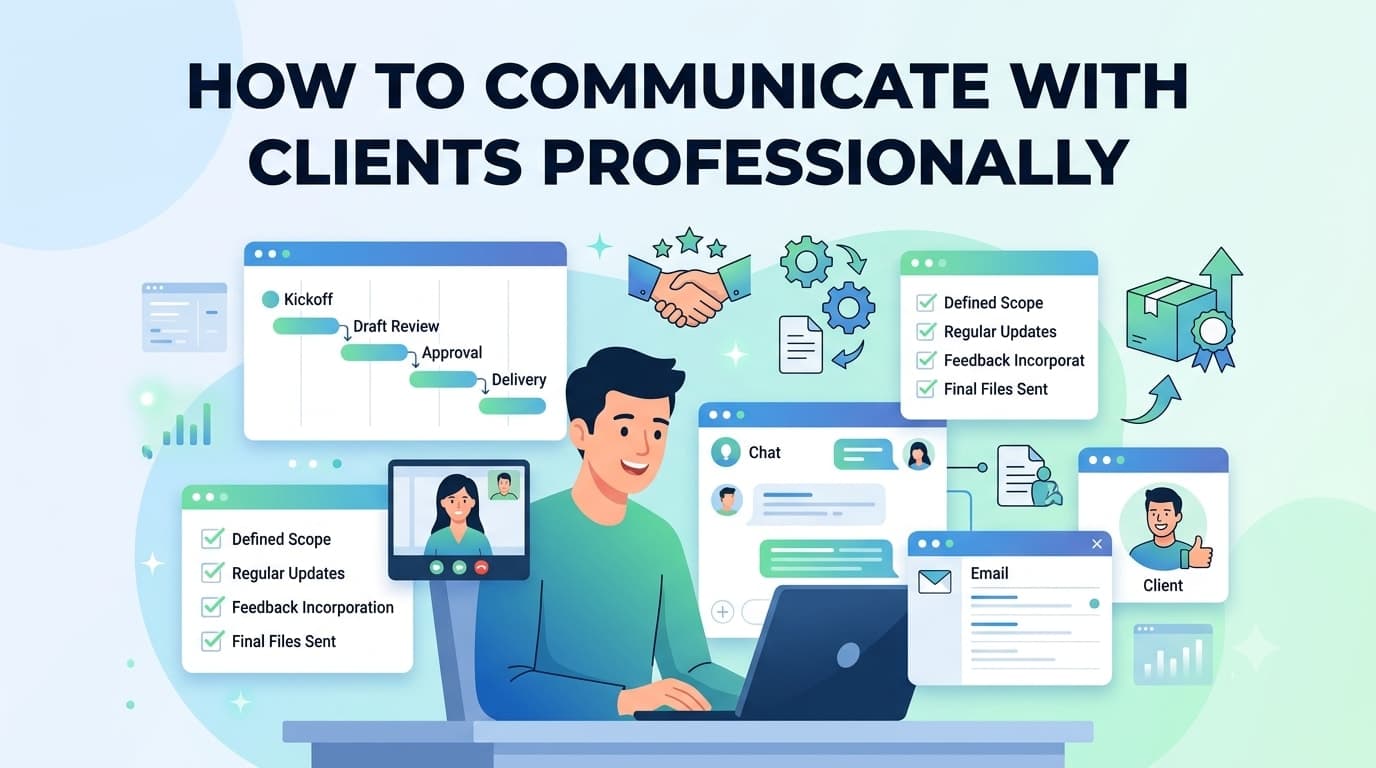
How to Communicate With Clients Professionally
Part 12
How to Avoid Freelancing Scams
Part 13
How to Get Repeat Clients
Part 14
How to Scale From Freelancer to Agency
Part 15
Passive Income Ideas for Freelancers
Welcome back to the Learn Freelancing for Beginners series!
Technical skills can help you win freelance projects, but communication is what helps you keep clients coming back.
Many beginners believe that freelancing is only about delivering great work. While quality is essential, it's only part of the equation. Clients also want freelancers who communicate clearly, respond professionally, manage expectations, and make collaboration easy.
Think about it from a client's perspective.
If two freelancers have similar skills, who would you choose?
The freelancer who replies days later, provides little information, and leaves you guessing about project progress.
Or the freelancer who responds promptly, explains everything clearly, provides regular updates, and handles questions professionally.
For most clients, the answer is obvious.
Professional communication builds trust, reduces misunderstandings, and creates a better experience for everyone involved.
In this article, you'll learn how to communicate confidently with clients before, during, and after a project. We'll also cover common communication mistakes, practical examples, and best practices that can help you build long-term client relationships.
Let's get started.
Why Communication Matters
Good communication is one of the biggest factors that separates successful freelancers from the rest.
Clients aren't just hiring your technical skills.
They're hiring someone they can trust to understand their requirements, solve problems, and keep them informed throughout the project.
Strong communication helps you:
Build trust with clients.
Avoid misunderstandings.
Reduce unnecessary revisions.
Deliver projects more smoothly.
Increase the chances of repeat business.
Receive better reviews and referrals.
Poor communication, on the other hand, can damage even the best technical work.
For example, imagine you complete an excellent website but don't respond to your client's messages for several days. Even though the final result is good, the client may hesitate to work with you again because the experience was stressful.
Professional communication isn't about writing long messages.
It's about being clear, respectful, honest, and consistent.
First Impressions Matter
Your first conversation with a potential client sets the tone for the entire project.
Clients often decide whether they trust a freelancer within the first few messages.
A professional first impression can increase your chances of winning projects and building long-term relationships.
Here are a few simple ways to make a great first impression:
Respond within a reasonable time.
Address the client politely.
Read the project description carefully before replying.
Avoid copy-paste messages.
Show genuine interest in the client's project.
Write clearly and professionally.
For example, instead of saying:
"I can do it."
Try saying:
"Thank you for sharing your project. I've reviewed your requirements and would be happy to help. I have experience with similar projects and would like to ask a few questions to better understand your goals."
A thoughtful response immediately shows professionalism.
Ask the Right Questions Before Starting
One of the biggest causes of project issues is assuming instead of asking.
Before accepting any project, make sure you fully understand what the client expects.
Useful questions include:
What is the main goal of this project?
Who is the target audience?
Do you have any design or branding guidelines?
Are there any examples you like?
What's your expected deadline?
What deliverables do you expect?
Will you provide the required content or assets?
How many revisions would you like?
These questions help you:
Understand the project better.
Estimate your time accurately.
Avoid misunderstandings later.
Deliver exactly what the client expects.
Clients appreciate freelancers who ask thoughtful questions because it shows you're paying attention to the details.
Listen More Than You Speak
Good communication isn't just about sending messages.
It's also about listening carefully.
When clients explain their ideas:
Read every message carefully.
Don't interrupt during calls.
Ask follow-up questions if something isn't clear.
Confirm your understanding before beginning work.
For example:
"Just to confirm, you'd like a responsive landing page with a contact form, three content sections, and integration with your existing branding. Is that correct?"
This simple confirmation can prevent hours of unnecessary revisions later.
Set Clear Expectations
Once you've understood the project, make sure both you and the client agree on the expectations.
Discuss topics such as:
Scope of work
Deliverables
Timeline
Number of revisions
Communication channel
Working hours
Payment terms
Don't leave important details open to interpretation.
When expectations are clear from the beginning, projects usually run much more smoothly.
Be Clear and Concise
Clients appreciate messages that are easy to read.
Avoid writing long paragraphs filled with unnecessary information.
Instead:
Use simple language.
Keep sentences short.
Organize information using bullet points when appropriate.
Highlight important decisions.
For example:
Project Update:
Homepage completed.
Mobile responsiveness finished.
Contact form integrated.
Product page currently in progress.
Expected completion: Friday.
This type of update is much easier to understand than a long block of text.
Respond Promptly
You don't need to reply within seconds.
However, you should aim to respond within a reasonable timeframe.
If you're unavailable for several hours, a short acknowledgment helps reassure the client.
For example:
"Thanks for your message. I've seen your request and will review everything this afternoon. I'll get back to you with a detailed update shortly."
This lets the client know their message hasn't been ignored.
Reliable communication builds trust.
Keep Clients Updated
One of the easiest ways to impress clients is by providing regular progress updates.
Many clients don't ask for updates because they assume you'll communicate proactively.
For longer projects, consider sending updates whenever you complete a major milestone.
For example:
Project started.
Initial design completed.
Development in progress.
Testing completed.
Ready for review.
Final delivery.
These updates reassure clients that the project is moving forward.
Even a short message every few days can make a significant difference.
Use Positive and Professional Language
The way you phrase your messages matters.
Instead of focusing on problems, focus on solutions.
Instead of saying:
"I can't do that."
Try:
"That feature isn't included in the current project scope, but I'd be happy to add it as an additional task if you'd like."
Or instead of:
"You're wrong."
Try:
"I think there may be a misunderstanding. Let me explain how this works."
Professional language keeps conversations productive and respectful.
Communicate Honestly
Never promise something you can't deliver.
If you're unsure about a requirement, say so.
If you need additional time, communicate it early.
Clients generally appreciate honesty more than unrealistic promises.
For example:
"I've encountered an unexpected technical issue that's taking a little longer than expected. I'm working on a solution and expect to have an update by tomorrow morning."
Being transparent helps maintain trust, even when challenges arise.
Handle Revisions Professionally
Revisions are a normal part of freelancing.
Even if you've done an excellent job, clients may request changes to better match their vision or business needs.
The key is to handle revisions professionally rather than taking them personally.
When a client requests changes:
Read all feedback carefully.
Thank them for their input.
Clarify any unclear requests.
Confirm what you'll update.
Complete the revisions within the agreed timeline.
For example:
"Thank you for your feedback. I've reviewed your comments and understand the requested changes. I'll update the homepage layout, adjust the button colors, and improve the spacing. I'll share the revised version by tomorrow."
This reassures the client that you've understood their feedback and have a clear plan.
Know the Difference Between Revisions and New Requirements
Not every client request is a revision.
Sometimes, clients ask for entirely new features after the project has already started.
For example:
Revision:
Change a button color.
Update text.
Adjust spacing.
Replace an image.
New Requirement:
Add a payment gateway.
Create additional pages.
Develop a new dashboard.
Integrate a third-party API.
If the request falls outside the agreed project scope, explain it professionally.
For example:
"I'd be happy to help with that feature. Since it wasn't included in the original project scope, I'll prepare a separate estimate and timeline before getting started."
This keeps expectations clear and prevents scope creep.
Manage Delays Professionally
Sometimes unexpected situations happen.
Perhaps you encounter a technical issue.
Maybe a dependency isn't working as expected.
Or perhaps a personal emergency affects your schedule.
The worst thing you can do is remain silent.
Instead, communicate as soon as possible.
A professional message might look like this:
"I wanted to keep you updated. I've encountered an unexpected issue while implementing one of the requested features. I'm currently working on a solution and expect to complete it by tomorrow afternoon. Thank you for your patience."
Clients usually appreciate honesty and proactive communication.
Most become frustrated only when they don't know what's happening.
Learn How to Say "No" Professionally
Not every client request should be accepted.
Sometimes a project is outside your expertise.
Sometimes the deadline is unrealistic.
Sometimes the requested budget doesn't match the amount of work involved.
It's perfectly acceptable to decline politely.
For example:
"Thank you for considering me for your project. After reviewing the requirements, I don't believe I'm the best fit for this particular project. Rather than risk delivering below your expectations, I think another specialist would be better suited. I truly appreciate the opportunity."
Or if you're unavailable:
"I'd love to help, but my current schedule won't allow me to give your project the attention it deserves. I appreciate your understanding and hope we can work together in the future."
A respectful "no" often leaves the door open for future opportunities.
Stay Professional During Difficult Conversations
Occasionally, you may work with a client who is unhappy or frustrated.
In these situations:
Stay calm.
Avoid emotional responses.
Focus on facts.
Listen before responding.
Offer practical solutions.
For example, instead of saying:
"That's not my fault."
Try:
"I understand your concern. Let's review what happened and find the best way to resolve it."
Professionalism during difficult conversations often leaves a stronger impression than when everything goes smoothly.
Finish Every Project Professionally
Many freelancers complete the work, send the files, and disappear.
Instead, end every project with professionalism.
Before marking a project complete:
Double-check your work.
Ensure all agreed deliverables are included.
Organize files clearly.
Provide simple instructions if needed.
Thank the client for the opportunity.
A closing message could look like this:
"Your project has been completed and all final files have been shared. Thank you for the opportunity to work with you. It was a pleasure collaborating with you, and I'd be happy to assist with any future updates or projects."
A positive ending increases the likelihood of repeat business.
Follow Up After Project Completion
Many freelancers miss opportunities simply because they never follow up.
A few weeks after completing a project, consider sending a friendly message.
For example:
"Hi! I hope everything is going well. I just wanted to check in and make sure everything is working as expected. If you need any updates or have new projects in the future, I'd be happy to help."
This simple gesture demonstrates professionalism and keeps you fresh in the client's mind.
Many repeat projects begin with a thoughtful follow-up message.
Common Communication Mistakes
Avoid these common mistakes that can damage client relationships.
Responding Too Slowly
Long delays without explanation can make clients feel ignored.
Even if you don't have a complete answer yet, acknowledge their message and let them know when you'll provide an update.
Using Informal or Unprofessional Language
Maintain a respectful tone throughout the project.
Avoid slang, excessive abbreviations, or overly casual responses.
Professional communication helps build confidence.
Making Assumptions
Never assume you understand a requirement without confirming it.
If something is unclear, ask.
A few questions at the beginning can prevent major revisions later.
Overpromising
Don't promise unrealistic deadlines or features just to win a project.
It's far better to set realistic expectations and exceed them than to disappoint a client.
Disappearing During the Project
Even if you're making good progress, complete silence can make clients anxious.
Regular updates—even brief ones—show that you're actively working and committed to the project.
Communication Checklist
Before, during, and after every project, review this checklist.
✔ I understood the client's requirements.
✔ I asked questions where needed.
✔ Expectations were clearly defined.
✔ I communicated professionally.
✔ I provided regular progress updates.
✔ I handled revisions respectfully.
✔ I informed the client about any delays immediately.
✔ I delivered the agreed work on time.
✔ I thanked the client after project completion.
✔ I followed up professionally after delivery.
Strong communication habits often lead to stronger client relationships and more repeat business.
Key Takeaways
Professional communication is one of the most valuable skills you can develop as a freelancer. It helps you build trust, reduce misunderstandings, and create a positive experience that encourages clients to work with you again.
Here are the most important lessons from this guide:
Make a strong first impression by responding professionally and showing genuine interest in the client's project.
Ask questions before starting to fully understand the client's requirements.
Set clear expectations for the project scope, timeline, deliverables, revisions, and payment terms.
Keep clients informed with regular progress updates instead of waiting for them to ask.
Handle revisions with a positive attitude and clearly distinguish between revisions and new requests.
Communicate honestly if delays or challenges arise.
Learn to decline projects professionally when they aren't the right fit.
Stay calm and solution-focused during difficult conversations.
End every project professionally and follow up afterward to build long-term relationships.
Remember, clients don't just remember the quality of your work—they also remember how easy you were to work with.
Frequently Asked Questions
How quickly should I reply to client messages?
You don't need to reply immediately, but it's good practice to respond within a few hours during your working hours or within one business day.
If you need more time to review the request, send a short acknowledgment so the client knows you've received their message.
What should I do if I don't understand the client's requirements?
Never guess.
Ask clear follow-up questions until you're confident you understand the project.
It's much easier to clarify requirements before starting than to make major changes later.
How often should I update my clients?
It depends on the project.
For small projects, updates at key milestones may be enough.
For larger or long-term projects, provide updates every few days or at agreed milestones so the client always knows the project's status.
What if a client becomes unhappy?
Stay calm and professional.
Listen carefully to their concerns, avoid becoming defensive, and focus on finding a practical solution. Most problems can be resolved through respectful communication.
Should I communicate through multiple platforms?
It's generally better to keep communication in one agreed-upon channel, especially while working through freelance platforms like Fiverr or Upwork.
Keeping conversations organized makes it easier to track decisions and project updates.
Is it okay to say no to a client?
Absolutely.
If a project falls outside your expertise, has an unrealistic deadline, or doesn't fit your schedule, politely declining is often the most professional decision. Saying no to the wrong project allows you to focus on opportunities where you can deliver your best work.
Continue Learning
📘 Learn Freelancing for Beginners Series
✅ Part 1: What Is Freelancing? A Complete Beginner's Guide
✅ Part 2: Skills You Can Sell as a Freelancer (Even With No Experience)
✅ Part 3: How to Choose the Right Freelance Skill for You
✅ Part 4: Best Freelancing Platforms for Beginners
✅ Part 5: How to Create a Winning Fiverr Profile
✅ Part 6: How to Create an Upwork Profile That Gets Approved
✅ Part 7: How to Get Your First Freelance Client
✅ Part 8: How to Build Your Portfolio Without Clients
✅ Part 9: How Much Should Beginners Charge?
✅ Part 10: Common Freelancing Mistakes Beginners Make
Final Thoughts
Clear, respectful, and professional communication is one of the biggest factors that separates successful freelancers from the rest. While technical skills may help you win a project, your communication skills often determine whether a client comes back for future work.
Every message you send represents your personal brand. Whether you're introducing yourself to a potential client, discussing project requirements, providing progress updates, or delivering the final work, each interaction is an opportunity to build trust and demonstrate professionalism.
As you continue your freelancing journey, make communication one of your greatest strengths. Listen carefully, ask thoughtful questions, keep clients informed, and always approach conversations with honesty and respect. These habits not only reduce misunderstandings but also create a positive working experience that clients remember.
The best freelancers aren't just known for delivering excellent work—they're known for making collaboration easy, enjoyable, and reliable.
In the next part of this series, we'll discuss how to handle difficult clients and resolve conflicts professionally, so you can confidently manage challenging situations while protecting your reputation and growing your freelance business.
Need Help? Let's Connect!
Your freelancing journey doesn't have to be a solo one. Whether you're choosing your first freelance skill, building your portfolio, setting your prices, creating your Fiverr or Upwork profile, improving your client communication, or growing your freelance business, we're here to help.
📩 Subscribe to Stay Updated
Don't miss the next article in our Learn Freelancing for Beginners series.
Subscribe to our blog and be the first to receive new articles, practical freelancing tips, and step-by-step guides delivered straight to your inbox. As the series grows, you'll have a complete roadmap to help you build a successful freelance career.
💬 Have a Question? We'd Love to Help
If you have any questions or need guidance at any stage of your freelancing journey, simply visit our Contact Us page and send us your query.
We personally read every message and do our best to respond to all genuine questions. Whether your question is about freelance platforms, client communication, pricing, portfolios, proposals, finding clients, or growing your freelance business, we'll be happy to help.
🤝 Connect With Us on LinkedIn
Follow us on LinkedIn for regular freelancing tips, AI tools, web development insights, career advice, and updates whenever a new article in this series is published.
If you found this article helpful, consider sharing it with your friends, colleagues, classmates, or anyone planning to start freelancing. It could help them communicate more confidently with clients and build stronger professional relationships.