Part 1
What Is Freelancing? A Complete Beginner's Guide to Starting Your Freelance Journey
Part 2
Skills You Can Sell as a Freelancer (Even With No Experience)
Part 3
How to Choose the Right Freelance Skill for You
Part 4
Best Freelancing Platforms for Beginners
Part 5
How to Create a Winning Fiverr Profile
Part 6
How to Create an Upwork Profile That Gets Approved
Part 7
How to Get Your First Freelance Client
Part 8
How to Build Your Portfolio Without Clients
Part 9
How Much Should Beginners Charge?
Part 10
Common Freelancing Mistakes Beginners Make
Part 11
How to Communicate With Clients Professionally
Part 12
How to Avoid Freelancing Scams
Part 13
How to Get Repeat Clients
Part 14
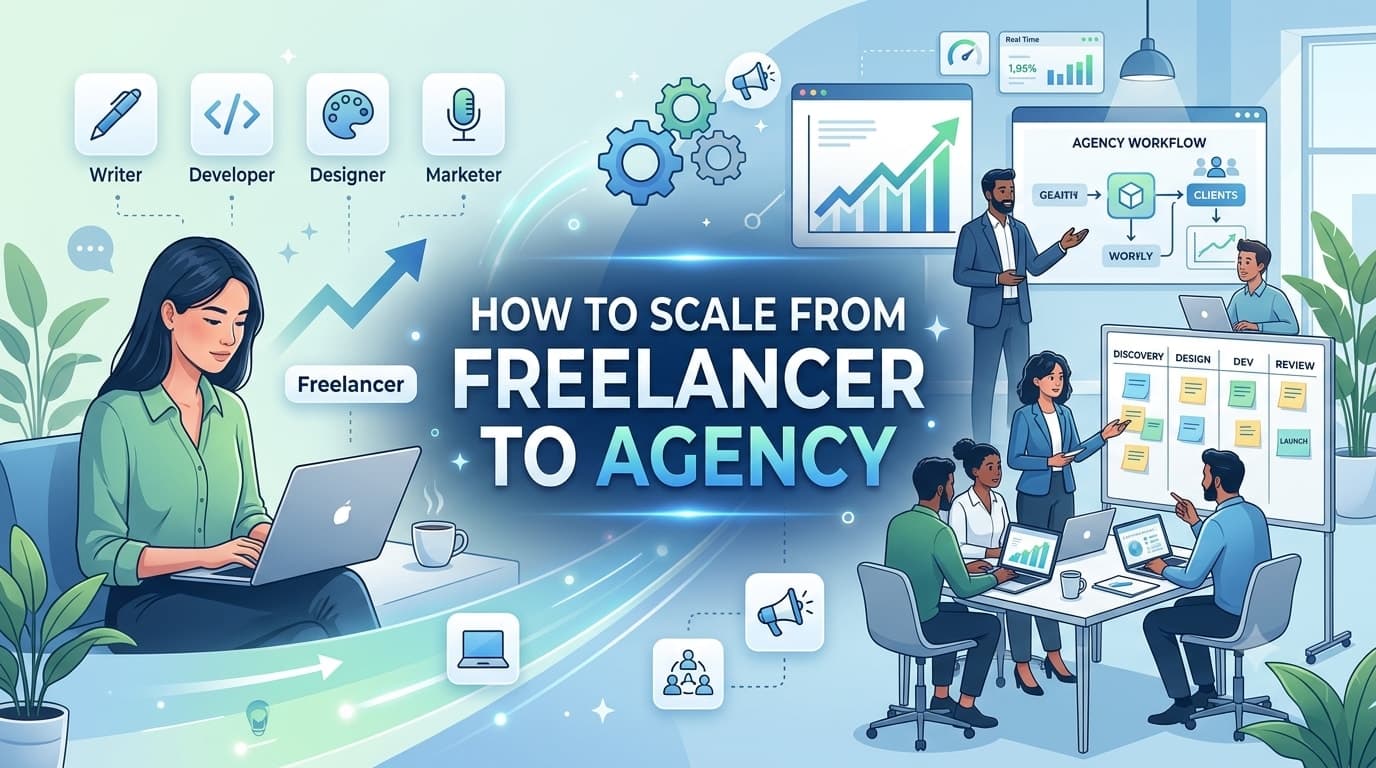
How to Scale From Freelancer to Agency
Part 15
Passive Income Ideas for Freelancers
Welcome back to the Learn Freelancing for Beginners series!
For many freelancers, success starts with landing the first client, delivering quality work, and building a strong reputation.
But after months or years of freelancing, many professionals face a new challenge.
There are only so many hours in a day.
No matter how skilled you become, your income eventually reaches a limit because you're trading your time for money.
This is where many freelancers begin thinking differently.
Instead of asking:
"How can I work more?"
they start asking:
"How can I build a business that grows beyond me?"
One of the most common ways to achieve this is by transforming a freelance business into an agency.
An agency allows you to serve more clients, offer additional services, build a team of specialists, and create systems that make your business more scalable.
However, becoming an agency owner isn't simply about hiring people.
It requires planning, leadership, communication, quality control, financial management, and a completely different mindset.
In this guide, you'll learn when it's time to scale, how to build your first team, common mistakes to avoid, and practical steps to transition from freelancer to agency owner successfully.
Let's get started.
What Does Scaling Mean?
Scaling doesn't simply mean earning more money.
Scaling means increasing your ability to serve more clients without doing all the work yourself.
As a freelancer, you're responsible for nearly everything:
Finding clients
Sales
Communication
Project management
Design or development
Testing
Delivery
Invoicing
Support
As your client base grows, handling everything alone becomes increasingly difficult.
An agency works differently.
Instead of completing every task yourself, you build a team where each member focuses on their area of expertise.
For example:
Developers build applications.
Designers create visuals and user interfaces.
Content writers produce articles.
SEO specialists improve search rankings.
Project managers coordinate communication and timelines.
Your role gradually shifts from completing tasks to leading people and improving business operations.
Scaling isn't about working harder.
It's about building systems that allow your business to grow sustainably.
Signs You're Ready to Build an Agency
Not every freelancer needs to start an agency.
Some professionals enjoy working independently and are perfectly happy staying solo.
However, if you consistently experience the following situations, it may be time to think about scaling.
You're Turning Down Projects
A great sign that your business is growing is when you receive more work than you can handle.
If you're regularly saying:
"Sorry, I'm fully booked."
you're already leaving revenue on the table.
Instead of declining projects, an agency can help you serve more clients without sacrificing quality.
You're Working Too Many Hours
Many freelancers reach a stage where they're working evenings, weekends, and holidays just to keep up.
If every new client means even longer working hours, your business isn't scalable.
An agency allows you to distribute work across a team instead of carrying everything yourself.
Clients Need More Services
Perhaps you're a web developer.
A client may also need:
UI/UX Design
SEO
Content Writing
Mobile Apps
Digital Marketing
Maintenance
Instead of referring clients elsewhere, an agency enables you to provide a complete solution through specialists.
This increases client satisfaction while creating additional revenue opportunities.
Your Income Has Reached a Ceiling
As a freelancer, your income usually depends on:
Hours × Hourly Rate
Eventually, you reach a point where increasing either becomes difficult.
Building an agency changes the equation.
Instead of earning only from your own time, your business can generate revenue through the work of multiple team members.
Freelancer vs Agency
Understanding the differences helps you decide whether scaling is the right choice.
Freelancer
You perform most of the work yourself.
Income depends on your availability.
Decisions are usually faster.
Lower operating costs.
Greater flexibility.
Limited capacity for large projects.
This model works well for specialists who enjoy hands-on work.
Agency
Work is shared across a team.
Larger projects become possible.
Multiple services can be offered.
Revenue isn't limited to one person's time.
Business systems become essential.
Leadership becomes more important than technical work.
Neither model is better than the other.
The best choice depends on your personal goals, preferred lifestyle, and long-term vision.
Build Systems Before Hiring
One of the biggest mistakes freelancers make is hiring people before creating a repeatable process.
Imagine hiring three developers when your projects are completely unorganized.
Everyone will ask:
Where are the project files?
Which version is correct?
Who talks to the client?
What's the deadline?
Who reviews the work?
Without systems, growth quickly becomes chaotic.
Before hiring anyone, document your workflow.
For example:
Receive client inquiry.
Schedule discovery call.
Prepare proposal.
Sign agreement.
Create project plan.
Assign tasks.
Weekly progress review.
Internal quality testing.
Client review.
Final delivery.
Follow-up.
When every project follows the same process, onboarding new team members becomes much easier.
Standardize Your Tools
As your agency grows, consistency becomes important.
Choose tools that everyone on your team will use.
For example:
Communication
Slack
Microsoft Teams
Google Chat
Project Management
Trello
ClickUp
Jira
Asana
Documentation
Google Docs
Notion
Confluence
File Sharing
Google Drive
Dropbox
OneDrive
Meetings
Google Meet
Microsoft Teams
Zoom
Using standardized tools keeps everyone aligned and reduces confusion.
Hire Slowly
Your first hires have a huge impact on your agency's future.
Avoid hiring too quickly simply because you're busy.
Instead:
Start with freelancers or contractors.
Give small paid trial projects.
Evaluate communication skills.
Check reliability.
Review work quality.
Assess professionalism.
Technical skills can be taught, but reliability and professionalism are much harder to develop.
A small team of dependable professionals is often more valuable than a large team with inconsistent performance.
Hire Complementary Skills
Don't hire people who are exactly like you.
Instead, fill the gaps in your business.
For example:
If you're a developer, consider hiring:
UI/UX Designer
QA Tester
Content Writer
SEO Specialist
Project Coordinator
If you're a designer, consider partnering with developers and marketers.
A well-balanced team can handle a wider variety of client projects.
Document Everything
As your team grows, relying on memory becomes impossible.
Create documentation for:
Client onboarding
Project setup
Coding standards
Design guidelines
Communication policies
Quality assurance
File organization
Delivery process
Documentation ensures every team member follows the same standards, even as your agency expands.
Managing Clients as an Agency
As a freelancer, clients communicate directly with you.
As an agency owner, communication becomes more structured.
Even if team members are doing the work, clients should always have confidence that the project is organized and progressing smoothly.
To provide a professional experience:
Assign a primary point of contact for each client.
Schedule regular progress updates.
Document meeting notes and decisions.
Share realistic timelines.
Inform clients about any risks early.
Keep communication clear and consistent.
Clients don't just hire an agency for technical expertise—they hire an agency because they expect reliability, organization, and professionalism.
Learn to Delegate Without Losing Quality
One of the hardest transitions from freelancer to agency owner is learning to let go.
Many freelancers think:
"It's faster if I just do it myself."
While that may be true initially, it limits your ability to grow.
Delegation doesn't mean giving up responsibility—it means creating a process where others can deliver work that meets your standards.
To delegate effectively:
Assign tasks based on each team member's strengths.
Provide clear requirements and expectations.
Set realistic deadlines.
Review completed work before sending it to the client.
Offer constructive feedback to help your team improve.
Think of yourself as a coach. Your role is to guide your team toward delivering excellent results, not to complete every task personally.
Build a Quality Assurance Process
As your agency grows, maintaining quality becomes increasingly important.
Clients expect the same level of excellence regardless of which team member works on their project.
A simple quality assurance (QA) process can help ensure consistency.
Before delivering any project, verify that:
All client requirements have been completed.
The work has been reviewed by another team member, where possible.
Errors and bugs have been fixed.
Files are organized properly.
Branding and design guidelines have been followed.
Documentation has been included if necessary.
A consistent review process helps reduce mistakes and strengthens your agency's reputation.
Build a Strong Team Culture
A successful agency isn't built solely on processes and tools—it also depends on people.
Encourage a culture of:
Respect
Accountability
Open communication
Continuous learning
Collaboration
Problem-solving
Celebrate achievements, recognize good work, and encourage team members to share ideas.
When people enjoy working together, they are more likely to produce better work for your clients.
Price Your Agency Services Correctly
Agency pricing is different from freelancer pricing.
As a freelancer, you mainly calculate the value of your own time.
An agency has additional costs, including:
Team salaries or contractor payments
Software subscriptions
Project management
Marketing
Administrative work
Taxes and business expenses
Quality assurance
When setting your prices, make sure they cover these costs while leaving room for profit.
Avoid competing solely on price.
Instead, emphasize the value your agency provides:
Access to multiple specialists.
Faster project delivery.
Reliable processes.
Ongoing support.
High-quality results.
Long-term partnership.
Clients are often willing to pay more for an agency that consistently delivers value and reliability.
Continue Building Your Personal Brand
Many agency owners stop building their personal brand after hiring a team.
This is a mistake.
People often choose an agency because they trust its founder.
Continue to:
Share valuable content on LinkedIn.
Publish helpful blog articles.
Speak at events or webinars.
Contribute to open-source projects.
Share client success stories (with permission).
Build your professional network.
A strong personal brand creates trust, attracts clients, and helps your agency stand out in a competitive market.
Common Mistakes When Scaling
Growing too quickly without preparation can create more problems than opportunities.
Here are some common mistakes to avoid.
Hiring Too Early
Don't build a large team before you have consistent work.
Grow gradually as demand increases.
A small, reliable team is easier to manage and less risky than hiring too many people too soon.
Trying to Do Everything Yourself
Many new agency owners continue handling:
Sales
Client communication
Development
Design
Hiring
Accounting
Marketing
Eventually, this leads to burnout.
Delegate responsibilities as your business grows so you can focus on strategy and leadership.
Ignoring Business Processes
Without clear processes, every project becomes different.
Document your workflows, templates, and standards so your team can deliver consistent results.
Choosing Price Over Quality
Hiring the cheapest available freelancers may reduce costs initially, but poor-quality work can damage your agency's reputation.
Focus on building a dependable team that consistently delivers high-quality results.
Neglecting Existing Clients
While searching for new business is important, don't forget your current clients.
Providing excellent service to existing clients often leads to repeat work, referrals, and long-term partnerships.
Agency Growth Checklist
Before expanding from freelancer to agency, ask yourself these questions.
✔ I have a steady flow of client work.
✔ My income is consistent enough to support growth.
✔ My workflows are documented.
✔ I use project management tools effectively.
✔ I have a quality assurance process.
✔ I understand my business expenses.
✔ I know which roles I need to hire first.
✔ I can delegate work without micromanaging.
✔ I focus on long-term client relationships.
✔ I'm building a business—not just creating more work for myself.
If you can confidently check most of these boxes, you're in a strong position to begin scaling.
Key Takeaways
Transitioning from freelancer to agency is about changing your mindset from doing all the work to building a business that can deliver value through a team.
The key lessons from this guide are:
Scale only when you have consistent demand.
Build systems before hiring people.
Standardize your tools and workflows.
Hire carefully and focus on complementary skills.
Delegate effectively while maintaining quality.
Develop strong leadership and communication skills.
Price your services to cover business costs and generate profit.
Continue building your personal brand as your agency grows.
Focus on long-term relationships with both clients and team members.
Remember, building an agency doesn't happen overnight. Start small, create reliable systems, invest in the right people, and grow at a pace you can manage.
Frequently Asked Questions
When should I transition from freelancer to agency?
There's no fixed timeline. Consider scaling when you consistently receive more work than you can handle, have reliable income, and have documented processes that others can follow.
Do I need employees to start an agency?
No. Many agencies begin by working with trusted freelancers or contractors before hiring full-time employees. This approach reduces risk while allowing you to expand your service offerings.
Should I stop freelancing completely?
Not necessarily. Many agency owners continue to work on key projects, sales, or technical architecture while delegating day-to-day implementation to their team.
How do I maintain quality as my team grows?
Create clear standards, document your processes, conduct quality reviews before delivery, and provide regular feedback to your team. Consistency is essential for building a strong reputation.
Is building an agency the right goal for every freelancer?
No. Some freelancers prefer the flexibility and independence of working solo, while others enjoy leading teams and building a business. Choose the path that aligns with your goals, lifestyle, and interests.
Continue Learning
📘 Learn Freelancing for Beginners Series
✅ Part 1: What Is Freelancing? A Complete Beginner's Guide
✅ Part 2: Skills You Can Sell as a Freelancer (Even With No Experience)
✅ Part 3: How to Choose the Right Freelance Skill for You
✅ Part 4: Best Freelancing Platforms for Beginners
✅ Part 5: How to Create a Winning Fiverr Profile
✅ Part 6: How to Create an Upwork Profile That Gets Approved
✅ Part 7: How to Get Your First Freelance Client
✅ Part 8: How to Build Your Portfolio Without Clients
✅ Part 9: How Much Should Beginners Charge?
✅ Part 10: Common Freelancing Mistakes Beginners Make
✅ Part 11: How to Communicate With Clients Professionally
✅ Part 12: How to Avoid Freelancing Scams
✅ Part 13: How to Get Repeat Clients
Final Thoughts
Scaling from a freelancer to an agency is an exciting milestone, but it requires more than simply hiring people. It requires a shift in how you think about your work, your clients, and your business.
As a freelancer, your success depends on your individual skills and the hours you can dedicate to client work. As an agency owner, your success depends on creating systems, building a reliable team, maintaining quality, and developing long-term client relationships.
You don't need to build a large agency overnight. Many successful agencies started with just one freelancer and one trusted collaborator. Focus on creating repeatable processes, hiring the right people, and delivering exceptional results consistently. As your experience and confidence grow, so will your business.
Whether you choose to remain a solo freelancer or build a thriving agency, remember that the ultimate goal is the same: delivering value to your clients while creating a career that supports your long-term personal and professional goals.
In the next part of this series, we'll explore how to build multiple income streams as a freelancer, helping you create a more stable and resilient freelance business.
Need Help? Let's Connect!
Your freelancing journey doesn't have to be a solo one. Whether you're just starting out, planning to grow into an agency, improving your client relationships, or building systems to scale your business, we're here to help.
📩 Subscribe to Stay Updated
Don't miss the next article in our Learn Freelancing for Beginners series.
Subscribe to our blog and be the first to receive new articles, practical freelancing tips, and step-by-step guides delivered straight to your inbox. As the series grows, you'll have a complete roadmap to help you build and grow a successful freelance business.
💬 Have a Question? We'd Love to Help
If you have any questions or need guidance at any stage of your freelancing journey, simply visit our Contact Us page and send us your query.
We personally read every message and do our best to respond to all genuine questions. Whether your question is about freelancing, scaling your business, building an agency, pricing, client management, or business growth, we'll be happy to help.
🤝 Connect With Us on LinkedIn
Follow us on LinkedIn for regular freelancing tips, AI tools, web development insights, career advice, and updates whenever a new article in this series is published.
If you found this article helpful, consider sharing it with your friends, colleagues, or fellow freelancers who dream of building an agency. It could help them take the next step from working alone to growing a successful business.