Part 1
What Is Freelancing? A Complete Beginner's Guide to Starting Your Freelance Journey
Part 2
Skills You Can Sell as a Freelancer (Even With No Experience)
Part 3
How to Choose the Right Freelance Skill for You
Part 4
Best Freelancing Platforms for Beginners
Part 5
How to Create a Winning Fiverr Profile
Part 6
How to Create an Upwork Profile That Gets Approved
Part 7
How to Get Your First Freelance Client
Part 8
How to Build Your Portfolio Without Clients
Part 9
How Much Should Beginners Charge?
Part 10
Common Freelancing Mistakes Beginners Make
Part 11
How to Communicate With Clients Professionally
Part 12
How to Avoid Freelancing Scams
Part 13
How to Get Repeat Clients
Part 14
How to Scale From Freelancer to Agency
Part 15
Passive Income Ideas for Freelancers
Part 16
AI Tools Every Freelancer Should Use
Part 17
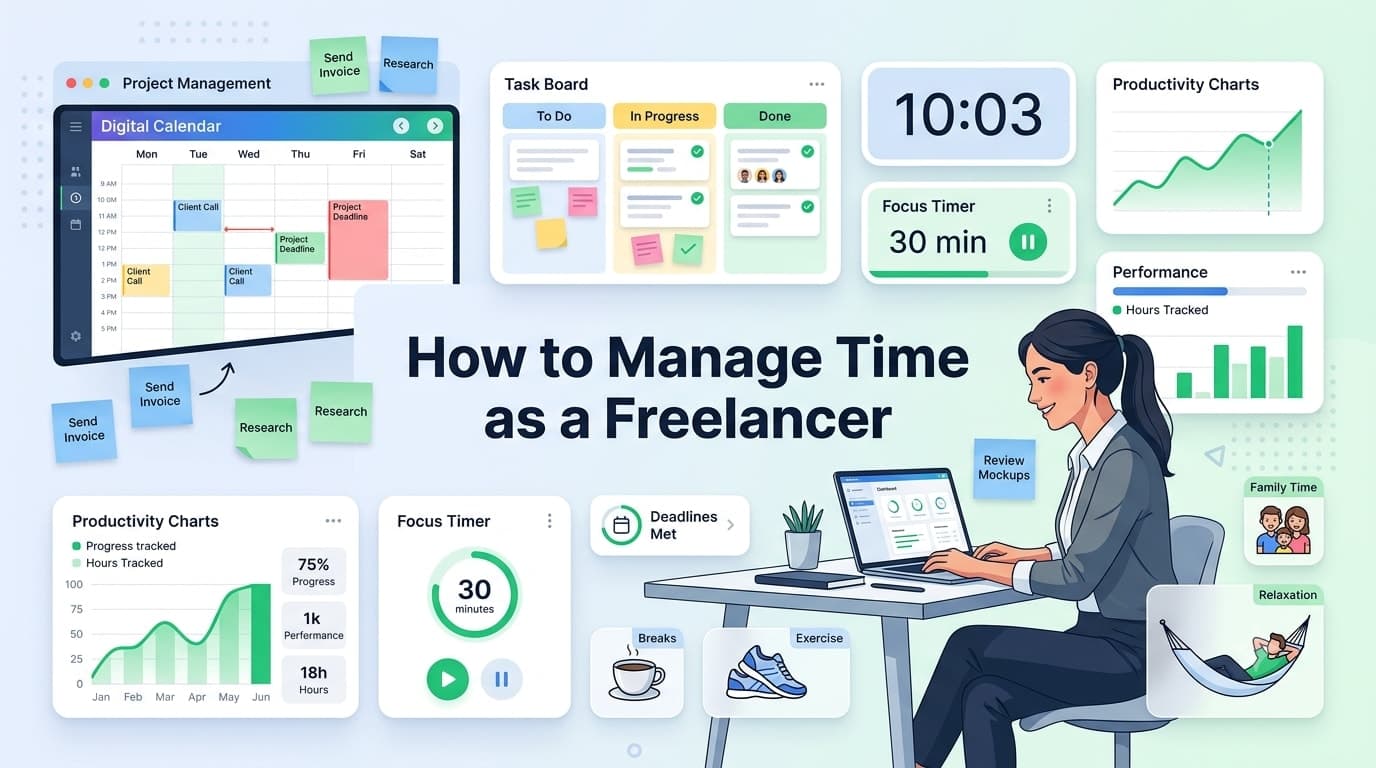
How to Manage Time as a Freelancer
Part 18
Freelancer Taxes and Payments Explained
Part 19
How to Build a Personal Brand as a Freelancer
Part 20
From Beginner to Full-Time Freelancer: A Step-by-Step Roadmap
Welcome back to the Learn Freelancing for Beginners series!
One of the biggest advantages of freelancing is having the freedom to choose when and where you work.
However, that same freedom can quickly become one of the biggest challenges.
Without a manager assigning tasks, fixed office hours, or someone checking your progress, it's easy to lose focus, procrastinate, or spend too much time on less important work.
Many freelancers struggle with:
Managing multiple clients.
Meeting deadlines.
Handling unexpected revisions.
Balancing work and personal life.
Avoiding distractions while working from home.
Feeling overwhelmed by an endless to-do list.
The truth is that successful freelancers aren't necessarily the ones who work the longest hours—they're the ones who manage their time effectively.
Good time management helps you deliver projects on schedule, reduce stress, maintain a healthy work-life balance, and create more opportunities to grow your freelance business.
In this guide, you'll learn practical strategies to organize your day, prioritize important work, minimize distractions, and build habits that improve productivity without leading to burnout.
Let's get started.
Why Time Management Matters
Freelancers don't just perform client work.
On any given day, you may also need to:
Respond to emails.
Attend meetings.
Write proposals.
Send invoices.
Market your services.
Learn new skills.
Update your portfolio.
Manage your finances.
Create content for social media.
Without proper planning, important work can easily be delayed while less valuable tasks consume your day.
Effective time management helps you:
Meet deadlines consistently.
Deliver better quality work.
Reduce stress.
Improve client satisfaction.
Increase your earning potential.
Create time for learning and personal growth.
Remember, being busy isn't the same as being productive.
Productivity means spending your time on work that creates the greatest value.
Create a Daily Routine
One of the biggest differences between successful freelancers and those who constantly feel overwhelmed is having a consistent daily routine.
Working whenever you feel motivated may sound appealing, but it often leads to inconsistent productivity.
Instead, create a schedule that works for your lifestyle.
For example:
Start work at the same time each day.
Review your priorities.
Focus on deep work during your most productive hours.
Schedule meetings during specific time blocks.
Take regular breaks.
Finish work at a consistent time.
A routine helps your brain switch into "work mode" and makes it easier to stay focused.
Plan Your Day Before It Starts
Don't begin your day wondering what to work on.
Spend 10–15 minutes at the end of each workday planning the next one.
Write down:
Your top priorities.
Client deadlines.
Meetings.
Follow-up tasks.
Administrative work.
When you start your day with a clear plan, you spend less time deciding what to do and more time getting things done.
Prioritize Your Most Important Tasks
Not every task deserves the same amount of attention.
A common mistake freelancers make is spending hours answering emails or making small revisions while delaying their most important projects.
Ask yourself:
"Which task will have the biggest impact today?"
Complete that task first.
For example:
High-priority tasks might include:
Client deliverables
Project deadlines
Important proposals
Sales calls
Lower-priority tasks may include:
Organizing files
Checking social media
Cleaning your inbox
Updating minor documents
Focus on work that moves your business forward.
Use Time Blocking
Time blocking is one of the simplest and most effective productivity techniques.
Instead of constantly switching between tasks, dedicate specific blocks of time to similar types of work.
For example:
9:00 AM – 11:00 AM
Client project work
11:00 AM – 11:30 AM
Emails and messages
11:30 AM – 1:00 PM
Deep work
2:00 PM – 3:00 PM
Meetings
3:00 PM – 5:00 PM
Learning, marketing, or content creation
Grouping similar tasks together reduces context switching and improves concentration.
Avoid Multitasking
Many freelancers believe multitasking increases productivity.
In reality, constantly switching between projects often slows you down.
For example:
Instead of:
Replying to emails
Editing a website
Answering Slack messages
Taking client calls
...all at the same time,
focus on completing one task before moving to the next.
Single-tasking usually produces higher-quality work in less time.
Set Realistic Deadlines
One of the fastest ways to become stressed is by promising unrealistic delivery dates.
When estimating project timelines:
Include time for revisions.
Consider unexpected problems.
Allow for testing or quality checks.
Avoid scheduling every hour of your day.
Clients generally appreciate honest timelines more than unrealistic promises.
Delivering earlier than expected creates a much better impression than constantly asking for extensions.
Learn to Say No
Not every project is worth accepting.
Taking on too many clients often leads to:
Missed deadlines
Lower-quality work
Stress
Burnout
Poor client relationships
Before accepting a project, ask yourself:
Do I have enough time?
Does this fit my expertise?
Can I deliver quality work?
Is the budget worth the effort?
Sometimes saying "no" to one project allows you to do a much better job on another.
Use Productivity Tools
The right tools won't magically make you productive, but they can help you stay organized and save valuable time.
Useful categories include:
Task management
Calendars
Time tracking
Note-taking
Project management
File sharing
Automation
AI assistants
If you're interested in AI-powered productivity tools, be sure to read our article "5 Best AI Tools for Productivity (Beginner Friendly)." It explores practical AI tools that can automate repetitive work, organize your tasks, and help freelancers accomplish more in less time.
Choose a small set of tools that fit your workflow instead of trying every new productivity app.
Batch Similar Tasks Together
Switching between unrelated tasks can reduce focus and efficiency.
Instead, group similar activities into dedicated sessions.
For example:
Respond to emails twice a day instead of checking them every few minutes.
Schedule all client meetings on specific days or during a fixed time window.
Create multiple social media posts in one session.
Process invoices together at the end of the week.
Batching reduces interruptions and helps you stay in a productive mindset.
Manage Multiple Clients Effectively
As your freelance business grows, you'll likely work with several clients at the same time.
To stay organized:
Keep separate folders for each client.
Maintain individual task lists.
Track deadlines in one calendar.
Communicate progress regularly.
Review upcoming deadlines every morning.
Avoid relying on memory.
A simple project management system can prevent missed deadlines and forgotten tasks.
Avoid Common Distractions
Working from home offers flexibility, but it also introduces distractions that can reduce productivity.
Some of the most common distractions include:
Social media
Mobile phone notifications
Television
Household chores
Unplanned meetings
Constant email checking
You don't have to eliminate every distraction, but you should minimize the ones you can control.
Here are a few practical tips:
Turn off unnecessary notifications during focused work.
Keep your phone away from your desk if it's distracting.
Use "Do Not Disturb" mode during deep work sessions.
Create a dedicated workspace whenever possible.
Let family members know your working hours.
Small changes can significantly improve your ability to stay focused.
Take Regular Breaks
Many freelancers believe working longer hours automatically leads to higher productivity.
In reality, working continuously for hours often reduces concentration and increases mistakes.
Instead, schedule short breaks throughout your day.
For example:
Stand up and stretch.
Take a short walk.
Drink water.
Rest your eyes from the screen.
Step outside for fresh air.
Even a five to ten-minute break can help you return to work with renewed focus and energy.
Remember, breaks are part of being productive—not a distraction from it.
Track Where Your Time Goes
Have you ever finished the day wondering where all your time went?
Time tracking helps you identify how you actually spend your working hours.
Track activities such as:
Client work
Meetings
Emails
Learning
Marketing
Administrative tasks
After a week, review the results.
You may discover that tasks like checking emails or attending unnecessary meetings consume far more time than expected.
Understanding how you spend your time is the first step toward improving it.
Build Healthy Work-Life Balance
One of the biggest challenges freelancers face is knowing when to stop working.
Because your office is often your home, work can easily spill into evenings and weekends.
To maintain a healthy balance:
Set clear working hours.
Finish work at a consistent time.
Avoid checking client messages late at night unless necessary.
Spend time with family and friends.
Make time for hobbies and exercise.
A healthy freelancer is more productive than an exhausted one.
Taking care of yourself isn't wasting time—it's an investment in your long-term success.
Prevent Burnout
Burnout doesn't happen overnight.
It usually develops after weeks or months of excessive workload and insufficient rest.
Common signs include:
Constant fatigue
Lack of motivation
Difficulty concentrating
Increased mistakes
Feeling overwhelmed
Losing interest in work
If you notice these signs:
Reduce your workload where possible.
Take a day off.
Prioritize sleep.
Exercise regularly.
Delegate tasks if appropriate.
Reassess your schedule.
Your health should always be more important than meeting one extra deadline.
Remember, freelancing is a marathon—not a sprint.
Review Your Progress Every Week
Productive freelancers don't just plan—they also review.
At the end of each week, ask yourself:
What did I accomplish?
Which tasks took longer than expected?
What distracted me?
Which clients need follow-up?
What can I improve next week?
A simple weekly review helps you continuously improve your workflow and avoid repeating the same mistakes.
Small improvements each week lead to significant progress over time.
Time Management Checklist
Use this checklist to improve your productivity as a freelancer.
✔ I start my workday with a clear plan.
✔ I focus on high-priority tasks first.
✔ I avoid unnecessary multitasking.
✔ I use time blocking for focused work.
✔ I batch similar tasks together.
✔ I minimize distractions while working.
✔ I track deadlines and client projects.
✔ I take regular breaks.
✔ I maintain a healthy work-life balance.
✔ I review my productivity every week.
Key Takeaways
Managing your time effectively is one of the most valuable skills you can develop as a freelancer.
Here are the biggest lessons from this guide:
Create a consistent daily routine.
Plan your work before the day begins.
Prioritize tasks that create the greatest value.
Use time blocking to stay focused.
Avoid multitasking whenever possible.
Set realistic deadlines for yourself and your clients.
Use productivity tools to stay organized.
Protect your focus by reducing distractions.
Take breaks and maintain a healthy work-life balance.
Review your progress regularly and keep improving.
Remember, productivity isn't about working more hours—it's about making the best use of the hours you have.
Frequently Asked Questions
How many hours should freelancers work each day?
There isn't a universal answer. Some freelancers work six focused hours, while others work eight or more depending on their workload. Instead of counting hours, focus on completing high-quality work efficiently while maintaining a healthy work-life balance.
What's the best productivity technique for freelancers?
Many freelancers find time blocking highly effective because it reduces distractions and helps maintain focus. Experiment with different techniques to discover what works best for your workflow.
How can I avoid procrastination?
Break large projects into smaller tasks, set clear deadlines, remove distractions, and begin with your highest-priority task. Starting is often the hardest part, so focus on taking the first small step.
Should I work on weekends?
Occasionally, you may need to meet an important deadline. However, regularly working without rest can lead to burnout. Schedule time off whenever possible to maintain your productivity and well-being.
Which tools help with time management?
Calendars, task managers, project management platforms, time-tracking software, and AI productivity tools can all help freelancers stay organized and work more efficiently. Choose tools that simplify your workflow instead of making it more complicated.
Continue Learning
📘 Learn Freelancing for Beginners Series
✅ Part 1: What Is Freelancing? A Complete Beginner's Guide
✅ Part 2: Skills You Can Sell as a Freelancer (Even With No Experience)
✅ Part 3: How to Choose the Right Freelance Skill for You
✅ Part 4: Best Freelancing Platforms for Beginners
✅ Part 5: How to Create a Winning Fiverr Profile
✅ Part 6: How to Create an Upwork Profile That Gets Approved
✅ Part 7: How to Get Your First Freelance Client
✅ Part 8: How to Build Your Portfolio Without Clients
✅ Part 9: How Much Should Beginners Charge?
✅ Part 10: Common Freelancing Mistakes Beginners Make
✅ Part 11: How to Communicate With Clients Professionally
✅ Part 12: How to Avoid Freelancing Scams
✅ Part 13: How to Get Repeat Clients
✅ Part 14: How to Scale From Freelancer to Agency
✅ Part 15: Passive Income Ideas for Freelancers
✅ Part 16: AI Tools Every Freelancer Should Use
Final Thoughts
Time is one of the few resources every freelancer has in equal measure, but how you manage it determines the success of your business. Developing good time management habits isn't about filling every minute with work—it's about focusing on the activities that create the greatest value for your clients and your career.
As your freelance business grows, your responsibilities will grow as well. You'll manage multiple clients, deadlines, proposals, invoices, learning, and business development. Without a structured approach, it's easy to become overwhelmed.
Start with small improvements. Create a daily routine, prioritize your most important work, minimize distractions, and review your progress regularly. Over time, these habits will help you become more productive, reduce stress, and create a healthier balance between work and personal life.
If you're looking to improve your productivity even further, don't miss our articles on AI Tools Every Freelancer Should Use and 5 Best AI Tools for Productivity (Beginner Friendly). They introduce practical tools that can automate repetitive tasks and help you work more efficiently.
In the next part of this series, we'll discuss how to stay motivated during slow freelance months and turn quiet periods into opportunities for growth instead of frustration.
Need Help? Let's Connect!
Your freelancing journey doesn't have to be a solo one. Whether you're organizing your daily schedule, managing multiple clients, improving productivity, or building a long-term freelance business, we're here to help.
📩 Subscribe to Stay Updated
Don't miss the next article in our Learn Freelancing for Beginners series.
Subscribe to our blog and be the first to receive new articles, practical freelancing tips, AI recommendations, and step-by-step guides delivered straight to your inbox.
💬 Have a Question? We'd Love to Help
If you have any questions or need guidance at any stage of your freelancing journey, simply visit our Contact Us page and send us your query.
We personally read every message and do our best to respond to all genuine questions. Whether your question is about productivity, time management, freelancing, or growing your business, we'll be happy to help.
🤝 Connect With Us on LinkedIn
Follow us on LinkedIn for regular freelancing tips, AI insights, web development articles, career advice, and updates whenever a new article in this series is published.
If you found this article helpful, consider sharing it with fellow freelancers and anyone looking to become more productive while maintaining a healthy work-life balance.